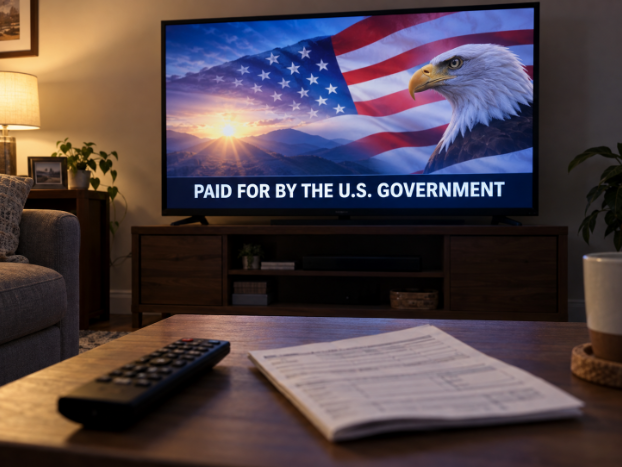
The ad looks like every Republican campaign spot you will see between now and November. Images of President Trump fill the screen for 30 seconds while singers croon the words love me in the background. “America will never be a communist country,” it declares, and boasts of the “largest tax cuts in history.” It ran during conservative programming on Fox News and Newsmax, aimed squarely at Republican viewers. Then comes the last frame, and the text at the bottom that makes this a different kind of story: paid for by the U.S. government. Not a campaign. Not a PAC. You.
The Associated Press surfaced the spot this week, with the ad tracking firm AdImpact putting the buy at 14,000 dollars. Fourteen thousand dollars is nothing in modern politics; a House race burns that before lunch. The money is not the point. The point is the disclosure line, because campaign messaging has a defined funding universe, candidates, parties, donors, PACs, precisely so that the machinery of government, funded by everyone, does not campaign for anyone. This ad does not tell you whom to vote for. It does not have to. It airs the president’s convention message, on the president’s favorite networks, to the president’s voters, 40 days before an election, on the public’s dime. The fig leaf is the only part of it that is subtle.
The White House does not deny paying. It calls the spot “educational and unapologetically patriotic.” Its statement went further: “These public service announcements are about reminding Americans to love their country and understand what makes it worth defending, at home, at our borders, and abroad.” Note the plural: announcements. This is presented not as one ad but as a category. What the White House would not say is which agency paid. You bought the airtime; the receipt does not itemize which of your accounts it came out of. Fox News and Newsmax did not respond to the AP’s questions.
The legal frame has a name: the Hatch Act, the law that bars federal employees from using government resources for political campaigns. Representative Jamie Raskin of Maryland, in line to chair the House Judiciary Committee if Democrats win the majority, says government employees working on such a video is a violation, calling the spot “blatantly unethical under numerous federal ethics provisions proscribing the use of government resources for political campaigns.” You would expect the opposition party to say that. Here is what you would not expect: Republicans agreeing on the record.
Senator Thom Tillis of North Carolina, who is retiring rather than seek reelection, reached for a comparison that should stop you cold: “It’s inappropriate. It’s not like they need a GoFundMe page to have the dollars to do that sort of ad and they could do it. But using taxpayer dollars, it feels like Viktor Orban.” That is a sitting Republican senator comparing his own party’s White House to Hungary’s strongman, whose signature move was folding state resources into permanent campaign infrastructure. Louisiana’s John Kennedy, no one’s idea of a Trump antagonist, said he had not seen the ad but questioned its legality: “I don’t generally like to see politicians use public money to pay for their own campaign ads.”
Is public money boosting incumbents new? Not entirely, and honesty requires the context. House members of both parties have long used the franking privilege to send self-promoting mail at public expense, 44 million dollars worth in the 2024 cycle, and members have spent roughly 1.4 million dollars in official funds on ads this cycle, per Axios. That is a bipartisan racket worth its own scrutiny. But franking is individual members promoting constituent services under rules Congress polices, however weakly. An executive branch television buy carrying the president’s campaign slogans on partisan networks is a different animal: the state itself, advertising for its incumbent, with no agency willing to claim the receipt.
Put it in the month’s ledger, because it fits. In three weeks we have covered a benefits database repurposed for voter purges, a detainee locator switched off for the people most in need of lawyers, three newsrooms banned until a court called it likely unconstitutional, and now the government’s own name on the bottom of a campaign style ad. The instruments differ. The direction does not: public machinery, angled toward November. Each entry is small enough to shrug at. The ledger is not.
The ad closes with five words: paid for by the U.S. government. For once, complete accuracy in political advertising. That is your treasury, your airtime, your name on the buy, promoting an agenda 55 percent of you told pollsters last week is hurting your own economy. The one message the government cannot buy, at any price, is the one you deliver in a voting booth. Yours airs November 3. Thirty nine days.