
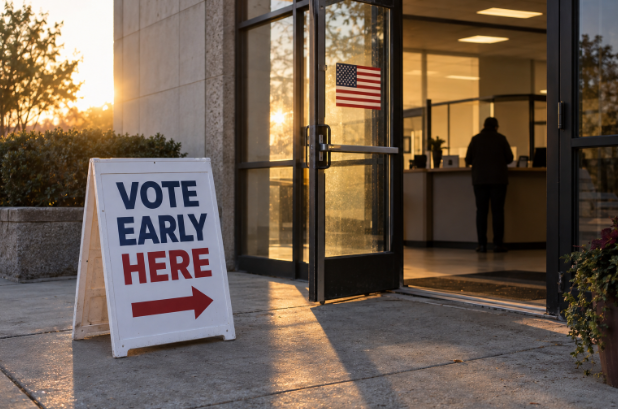
This morning, somewhere in Idaho, Minnesota, South Dakota or Virginia, a voter walked into an election office and cast the first early in person ballot of the 2026 midterms. Those four states opened early voting today, the earliest in the nation. North Carolina has been mailing absentee ballots since early September, the first state to send them. The election is not coming anymore. It is here, and it runs 46 days.
Stop on what did not happen this morning. For six months, the administration fought to change the rules these ballots move under: an executive order restricting mail voting, a Postal Service rule to screen ballot envelopes, three emergency trips to the Supreme Court. On Monday night the Court said no for the last time this cycle, leaving the rule blocked through the election. So the voting that began today began under the rules election officials have trained on for years, the ones your ballot instructions already describe. That is not a small thing. It is the whole thing.
Here is the country’s calendar from this morning forward. Forty seven states and Washington, D.C. offer early in person voting to every voter, covering 97 percent of voting age citizens; only Alabama, Mississippi and New Hampshire still require an excuse. Most states open in mid October, and Kentucky opens last, on October 29. Mail voting is broader still: 37 states plus D.C. let any voter request a mail ballot, eight states and D.C. mail one automatically to every active registered voter, and 17 states plus D.C. begin mail voting this month. New Jersey must have ballots in the mail by tomorrow.
If you plan to vote by mail, the deadline that matters is the one at the end. Thirty five states require your ballot to arrive by Election Day, not be postmarked by it. Fifteen states and D.C. do count ballots postmarked by November 3 that arrive later, with windows ranging from three days in Virginia, Kansas and Massachusetts to twenty in Washington state. Check your state’s rules at vote.gov, request early, and mail early. The Postal Service you are relying on is the same one whose leadership spent the summer in front of judges.
Two Supreme Court questions still hang over the season that started today. In Watson v. Republican National Committee, the Court is weighing whether federal law preempts the state laws that allow those post Election Day receipt windows; a ruling for the challengers could shrink mail deadlines in 15 states and D.C. with voting underway. And the purge database case we have followed for a week remains fully briefed and undecided, with 67 million voters’ records in the balance. Ballots are moving while both questions sit open. Whatever the Court does now, it does to an election in progress.
There is a reason early voting exists, and this year states the case better than any brochure. When everyone votes on one day, one problem, a broken machine, a power outage, a rumor engineered to land at 6 a.m., can hit millions at once with no time to fix it. When voting spreads across six weeks, problems surface early, officials adjust, and a voter who hits a snag on a Tuesday can come back Thursday. A 46 day election is harder to break than a one day election. That is not an accident. It is the design.
So here is where the story we have written all month actually lives now. Not in a courtroom, not in a dot plot, not in a press release. It lives in an election office lobby in Boise or Bloomington or Sioux Falls or Blacksburg, where the first ballots of the midterms went into the box this morning under rules that survived everything thrown at them. The line forms behind those voters, state by state, week by week, until it reaches you. November 3 is the last day to vote, not the first. That day was today. Forty six remain.