
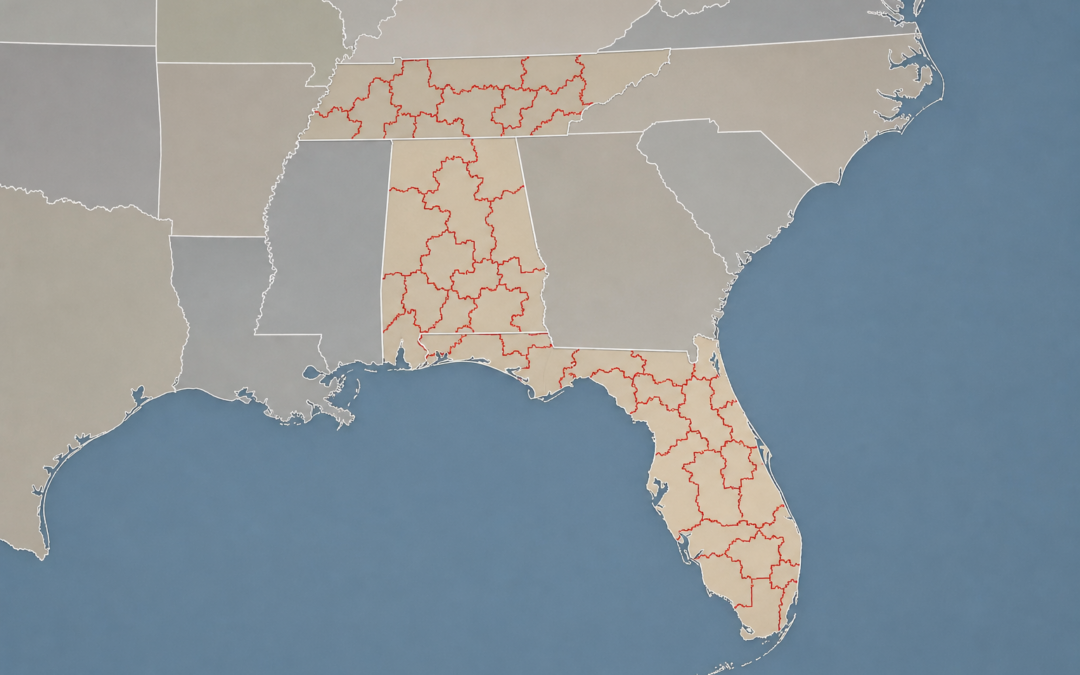
The ink was barely dry on the Supreme Court’s Voting Rights Act ruling when the scramble began. Within 48 hours of the 6-3 decision limiting the law’s power to protect minority voters, the Republican governors of Alabama and Tennessee had called their legislatures into special sessions to redraw congressional maps.
Florida had already moved within the hour of the ruling. Now two more states were following. The redistricting war the Supreme Court made possible on Wednesday is moving faster than almost anyone expected.
What Alabama Is Doing
Alabama currently sends five Republicans and two Democrats to Congress. The two Democratic seats exist because federal courts repeatedly ordered Alabama to draw a second majority-Black district after the state refused to comply with earlier Voting Rights Act requirements.
Wednesday’s ruling changed the legal landscape entirely. Governor Kay Ivey called the special session Friday, saying she wanted Alabama prepared to use its previously drawn congressional map if the courts allow it. That map has one majority-Black district instead of two. “By calling the Legislature into a special session, I am ensuring Alabama is prepared should the courts act quickly enough to allow Alabama’s previously drawn congressional and state Senate maps to be used during this election cycle,” Ivey said.
Alabama’s primaries are scheduled for May 19. The window to act is narrow. But Republicans are moving anyway.
What Tennessee Is Doing
Tennessee has one Democrat left in its congressional delegation: Representative Steve Cohen, whose Memphis-area seat was drawn to represent a majority-Black district. Governor Bill Lee called a special session Friday with Cohen’s seat squarely in the crosshairs.
“We owe it to Tennesseans to ensure our congressional districts accurately reflect the will of Tennessee voters,” Lee said. What he did not say is that Tennessee voters who are Black have consistently elected Cohen, and that the entire purpose of the special session is to redraw the district in a way that makes his seat noncompetitive or eliminates it entirely.
The Broader Scramble
Alabama and Tennessee are not alone. Georgia Governor Brian Kemp said his state would not redraw maps before November but confirmed he expects new maps before the 2028 elections. Pressure is building in South Carolina as well. Ohio, where tribal populations had forced the creation of VRA-protected districts, is also being watched.
The Hill reported that the ruling has set off “redistricting chaos” across multiple states, with Republicans in each assessing how quickly they can move and what legal risk remains under the new standard. The answer to the legal risk question, based on Wednesday’s ruling, is: significantly less than before.
The House Majority Math
Before Wednesday’s ruling, Democrats appeared to be ahead in the national redistricting fight. California’s maps added five Democratic-leaning seats. Virginia’s April 21 vote added four more. A court-ordered change in Utah added one. That was ten Democratic gains.
Florida’s new map, passed within the hour of the ruling, erased four of those gains. Alabama’s potential map could cost Democrats one more seat. Tennessee’s map could eliminate Cohen’s seat entirely. Georgia, South Carolina, and others could follow before November or before 2028.
The redistricting war that Republicans started — and that Democrats appeared to be winning two weeks ago — has shifted dramatically in the span of 72 hours.
What Comes Next
Legal challenges are already being filed. Civil rights groups have moved quickly in both Alabama and Tennessee to contest the special sessions and any maps that emerge from them. Whether those challenges succeed now depends on courts interpreting Wednesday’s ruling, a ruling written to make exactly these kinds of challenges harder to win.
The 1965 Voting Rights Act was designed to prevent states from drawing maps that dilute the political power of minority voters. Wednesday’s ruling did not erase it. What it did was remove the legal teeth that had stopped Alabama from defying it for years.
Alabama is now calling a special session. Tennessee is following. The law that was supposed to prevent this is still on the books. The mechanism that enforced it is not.