
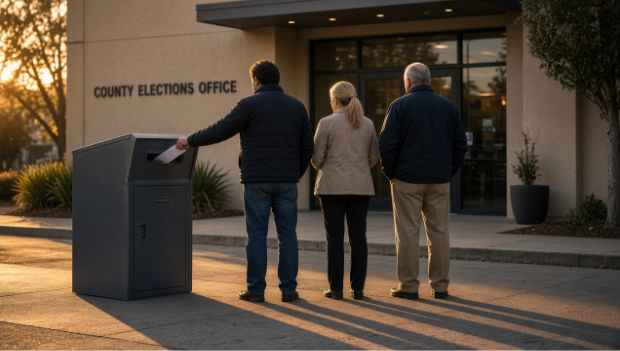
The lawsuit landed in federal court last Thursday, and its central request is simple to state. The Justice Department wants a judge to make California set aside the mail ballots of roughly 20,000 people the government calls likely noncitizens, leaving those votes uncounted until each person’s citizenship is confirmed. The department insists this is not a purge, and as a technical matter it is not. It is something elections have fewer defenses against, a hold placed on specific ballots in the biggest state in the country, filed after every registered Californian had already been mailed a ballot, in the state carrying more competitive House seats than any other. The 20,000 names amount to fewer than one in a thousand of California’s registered voters. The margin in several of those House districts is smaller than that.
The suit was the middle rung of a one week escalation. Tuesday, a senior Justice Department official named Trent McCotter sent letters to California’s secretary of state and the Los Angeles County clerk, demanding they open a password protected thumb drive said to contain the names, with 48 hours to comb through it. Thursday, the department sued. Friday, it escalated again, threatening to criminally prosecute local election workers who knowingly tabulate ballots cast by noncitizens, while separately publicizing dozens of arrests of alleged noncitizens accused of voting in past elections. Three moves in four days, each one louder, all of them inside the final three weeks before the vote.
Now the biography of the number, because it has lost 90 percent of its weight on the way to the courthouse. In July, federal officials alleged 190,000 noncitizens were registered in California. By last Thursday, one Justice Department filing said tens of thousands. The lawsuit itself says around 20,000, attributed to a Homeland Security Investigations unit that reasonably believes it, alongside a citizenship agency review described as high confidence. California Secretary of State Shirley Weber says no list was ever actually delivered to her office, and the thumb drive remains unopened because, in the state’s view, the demand itself was unlawful. A claim that shrinks from 190,000 to 20,000 before its first hearing is testifying to its own error rate.
The track record behind such lists supports the skepticism. Administration compiled rosters of supposed noncitizen voters have already been found substantially wrong in Nevada, Pennsylvania and New Jersey, snaring naturalized citizens and data mismatches. The kernel of truth in California is old, a 2018 state audit found the DMV’s motor voter rollout produced registration errors, which the state litigated and fixed years ago. ABC’s review of the current suit notes it is not clear how many of the likely noncitizens on the government’s list will prove to be legitimate voters, and election law experts overwhelmingly expect the suit to fail.
The legal walls it faces are not subtle. Federal law puts states, not Washington, in charge of running elections and maintaining rolls, and the National Voter Registration Act forbids systematic changes to those rolls within 90 days of a federal election, a window that closed in early August. The department’s own Civil Rights Division, which lost an unbroken string of voter roll cases over the past year, more than two dozen by one count, is conspicuously absent from this filing, which runs through other offices instead. And there is a live court order problem. A federal judge ruled just this month that the department unlawfully sought state voter rolls to cross check against a federal immigration database. Common Cause, which won that order, has told the judge this lawsuit may violate it, and asked the court to act. The government is now litigating around its own injunction.
California’s answer has been categorical. Weber says the department’s relentless efforts to access protected voter data and purge rolls serve only to cause chaos and fuel public distrust, and notes state law already requires citizen only registration and continuous removal of ineligible registrants. Governor Newsom calls the suit a desperate attempt to suppress California voters three weeks before Election Day. The Los Angeles County clerk answered the original demand with one measured sentence about following federal and state law. Underneath the statements sits the practical stake for anyone wrongly on the list, a lawful voter’s ballot held in limbo while an agency confirms what their passport already says, in a program whose previous rounds, by the court’s own order, removed actual citizens from rolls in other states.
This is the newest room in a building this newsletter has been walking through all month. ICE reviewed tens of millions of voter records nationwide. The federal citizenship database fight produced the very injunction now in play. The census plan to exclude noncitizens from the 2030 count is headed to court. The administration pressed the Supreme Court twice over mail ballot rules. And now a suit to impound ballots in the biggest state, which also attacks California’s signature verification procedures, the same procedures a Republican ballot measure, Proposition 39, asks voters to rewrite next month. When a lawsuit’s arguments double as a campaign’s arguments, the courtroom is doing airtime’s job.
The honest accounting owes the other side its due. Noncitizen registration does occur in small numbers, states find and remove it, and prosecuting actual noncitizen voting is legitimate. The department frames this as enforcement, with Attorney General Blanche declaring state facilitated voter fraud unacceptable. If the 20,000 names were handed over in a verifiable form and checked quickly, the dispute could deflate on its own arithmetic. What the department has not explained is why a routine list maintenance question requires a thumb drive ultimatum, a counting injunction and prosecution threats, all inside the one window when federal law says rolls are supposed to be left alone. The court may answer with the 90 day rule and the existing order, which is precisely why the experts expect a short case.
So the watch list for readers is concrete. The first hearing date. The judge’s response to Common Cause’s motion that the suit violates the existing order. Whether the 20,000 names are ever produced in public, checkable form. And whether a single lawful California voter finds their ballot held. The ballots are already moving through the mail. The question of whether they all get counted is now sitting on a federal docket, and the answer arrives on the law’s schedule, not the campaign’s.