
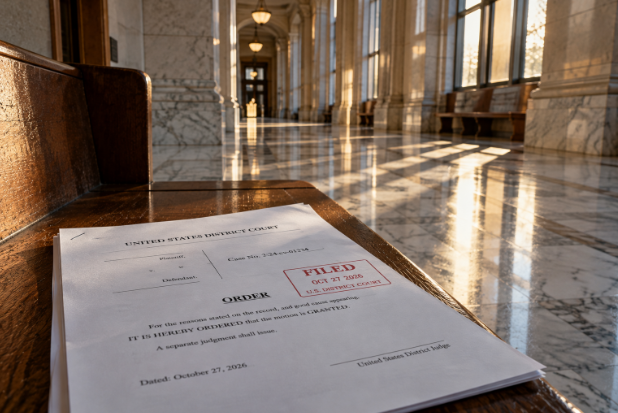
The week the machinery met the judiciary ended Wednesday night, and the scorecard fits in a paragraph. A federal judge in California rejected the administration’s emergency demand to set aside 20,000 mail ballots, writing that it would wreak havoc on an election already underway, chill election workers and voters alike, and discount the votes of United States citizens. Two days earlier, a federal appeals panel had turned away the same demand. The same Wednesday, the judge in the Alaska certification case opened his first hearing with open skepticism of the department’s maneuvering, and the Justice Department itself announced that no ICE or FBI agents will be embedded with its election monitors. Five days before the vote, every door the administration knocked on this month returned the same answer. This piece is the scorecard, what each ruling actually said, what remains open, and what none of it changes about a ballot already in the stream.
Start with what Judge David Carter actually ruled, because the language will outlive the case. The request, he wrote, violates longstanding constitutional principles mandating that states have control over their elections, and if such last minute relief were granted, either party could create chaos for their own political purposes to disrupt the election process. Over 20,000 registered Californians, he wrote, would potentially lose the right that generations of Americans have fought to preserve. The reasoning underneath was just as unsparing. The government likely lacks standing and a cause of action, the criminal ban on noncitizen voting gives the department no authority to override a state’s ballot processing, the remedy itself would likely violate several federal voting laws, and the claimed emergency arrived, in the court’s words, solely due to the government’s own neglect, a reference to a list handed to Los Angeles County on October 13, two weeks after ballots had already gone out, with a 48 hour deadline attached. He questioned whether the 20,000 figure was even accurate, and he named the lawful path that remains wide open, investigate and prosecute specific violations where the evidence supports it.
The appellate chapter came first and set the table. After an emergency Sunday hearing held over Zoom, a Ninth Circuit panel ruled 2 to 1 on Monday that it had no authority to act before the district court did, with Judge Mark Bennett, a Trump appointee, joining Judge Gabriel Sanchez in the majority. Sanchez wrote separately that the government was asking a federal court to dictate to a state legislature a matter squarely within the state’s traditional domain, inviting disorder and confusion for voters and election officials alike. The case went back down to Carter, who answered Wednesday. Appeals can continue, and nothing in litigation is ever fully over, but as of this morning California is counting its ballots under its own procedures, which is what the state asked for and what the administration sued to stop.
Alaska and the walkback filled out the week. In Anchorage, the judge hearing the suit to block certification if the Democrat wins pressed the department on its legal maneuvering at the first hearing, the early tell this page flagged as the watch item. In Washington, the department publicly announced that its election monitors will deploy without ICE or FBI agents embedded, a sentence that only needed saying because of the month that preceded it, the armed agents authority a Virginia county sued over, the prosecution threats a judge has already ordered to cease, and the sequester demands now pending in a second state. Two more lines from the same docket deserve a clause each, pending fuller reporting. A court has told the department that threats against election workers must cease immediately, and the prosecutor leading the California case was disqualified from his post, with that order stayed. The machinery is not just losing. Parts of it are being taken apart mid stride.
Alaska supplied the week’s political footnote too. Senator Lisa Murkowski, the state’s senior Republican, endorsed the Democrat in the governor’s race, saying the Republican candidates are too partisan, days after the Justice Department sued her state’s election division over a race it has not lost yet. The crossover ledger this page ran two weeks ago, governors, chairmen, a secretary of state, now includes a sitting United States senator. One endorsement decides nothing. A sitting senator declining to defend her own party’s slate in the state where the certification suit lives is a tell by any method, including ours.
The dissent gets its paragraph, because the government’s argument has a serious author. Judge Patrick Bumatay, a Trump appointee, wrote that the panel should have granted relief, that federal law precludes California from commingling ballots likely cast by aliens with legitimate ones because it encourages illegal voting. That is the strongest version of the administration’s position, stated by a federal judge, and it lost, 2 to 1 on procedure Monday and on every substantive front Carter reached Wednesday. The disagreement is real and will continue on appeal. The scoreboard, for this election, is what it is.
What remains open belongs in plain view. Washington state’s sequester demand is unanswered, and reporting suggests the department has more states queued behind it. The Alaska suit survives, with its condition that only triggers if the count comes out one way. The million dollar fraud bounty stands, generating claims that can seed the next round of filings. And the test the intelligence committee Democrats named weeks ago, what happens after the results, is untouched by anything a court said this week. October’s rulings settled who counts before the vote. November 4 settles whether anyone accepts what was counted, and the president’s own formulation, if they’re honest, is still the operative sentence.
The honest accounting runs the same both ways it has all month. Prosecuting actual noncitizen voting remains legitimate and available, Carter said so in his own ruling, and this week’s charges against two provocateurs in Minnesota show the normal channel working without any ballot being held hostage. The administration’s stated frame is integrity, and its lawyers will say the appeals vindicate it yet. Against that sits the court’s own nonpartisan version of the principle, that if eleventh hour federal demands could set aside ballots, either party could manufacture chaos for advantage, which is precisely why no party gets to. The two dozen voter roll defeats of the past year now have a week of company, delivered by judges appointed across three presidencies.
So the service close, unchanged and five days from final. A banked ballot sits outside every docket described above, early windows are open in most states through the weekend, mail ballots belong in drop boxes now rather than mailboxes, and your status is checkable online in two minutes. The watch list is short, Washington’s answer, Alaska’s schedule, any appeal of Carter’s order. And the ledger line for the week writes itself. The government asked three states to make their counting wait for its permission. The courts said the counting does not wait. The ballots never did.