
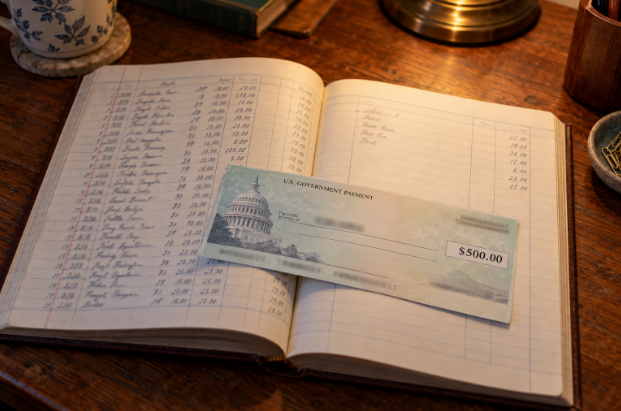
Twice in four days, President Trump posted a video promising 5,000 dollars to every adult citizen in America if Republicans keep the House and Senate. Only he could make the promise, the first video said. The second said it would be easy, because tariff money and a booming economy would cover it. A promise that size deserves the treatment this newsletter gives every large number, which is a ledger. Every cash payment this administration has promised in one column. Every check that actually went out in the other. The arithmetic between the columns is the story, and it does not take long to read.
Start with the price of the new one. There are roughly 250 million adult citizens in the United States, which puts a universal 5,000 dollar payment at about 1.2 trillion dollars, around half again the annual Pentagon budget, for one round of checks. The Tax Foundation’s Erica York ran it against the funding source the president named and found that a single year of these checks would consume roughly a decade of projected tariff revenue. The payment would also require Congress to appropriate the money. No bill exists, no committee is drafting one, and the promise itself is conditioned on an election that has not happened. For scale, the entire ACA refund program that mailed real checks this month cost about 500 million dollars. The new promise is roughly 2,400 times that size.
Now the promised column, in order. In February of last year it was the DOGE dividend, 5,000 dollars per household from government efficiency savings, which faded as the claimed savings shrank under scrutiny. Then came the tariff rebate, 2,000 dollars per person, promised for November, then for the end of the year, then not mentioned. Then, at his party’s midterm convention in Dallas last month, the 5,000 dollar midterm dividend, repeated twice this month in the videos above. By one financial press count, that makes at least the fourth cash payment promised to Americans this term, and the first offered explicitly on the condition that voters deliver a specific election result.
The delivered column is shorter and the numbers are smaller. The largest broad payment to actually go out is the 500 dollar Affordable Care Act refund, mailed to about 950,000 people who paid full price on the federal marketplace, roughly one marketplace customer in twenty, a program this newsletter covered in detail. A Medicare premium rebate of about 90 dollars is scheduled for seniors. Payments of 1,776 dollars went to service members under the name Warrior Dividend. Bonuses of 10,000 dollars went to a few hundred air traffic controllers. And newborns get 1,000 dollar investment accounts under last year’s tax law. Two of those are narrow by design, the controller bonuses reached a workforce of a few hundred and the accounts begin at birth, so the broad based entries in the delivered column remain the 500 dollar refund and the pending Medicare rebate. Add every delivered and scheduled item together and the total is a rounding error against 1.2 trillion, well under one percent of the number being promised.
The honest reading runs both directions, so here it is. The delivered checks are real money to the people who received them, and a refund can be legitimate, the marketplace fee surplus behind the 500 dollar checks has a defensible logic we laid out at the time. The ledger’s question is not whether any checks exist. It is the ratio of announcement to arrival, and the pattern in the dates. The small checks land before the election. The big ones sit on the far side of it, behind a vote, behind a Congress, behind a deadline that has already moved twice.
Is promising money for an election outcome even legal. Election law scholars say almost certainly yes. Candidates and parties have always promised policy benefits to voters, the standard example being George McGovern’s 1972 pledge of 1,000 dollars for every American, and the law draws its line at paying specific individuals for their individual votes, not at campaign promises of universal payments. So there is no courtroom remedy here and none needed. The remedy is the one this page is performing, which is arithmetic. The separate question worth tracking is institutional, whether official government channels, rather than a personal or campaign account, ever promote a payment conditioned on an election result, the question already raised about the government funded ads this fall. The promise videos so far have run on his personal account.
One more check on the funding claim, because it does double duty. Tariff revenue is real and large, and it is also contested, the legal authority behind a chunk of it is in front of the Supreme Court this term, and the tariffs themselves are paid at the register, in import prices, by the same adults to whom the 5,000 dollars is being promised. Run that loop in full and the mechanism is circular. The money for the check would come, in meaningful part, from the people receiving the check, collected at the grocery store and the hardware store along the way.
What a reader does with this is simple. Treat any promised check the way you treat weather more than ten days out, interesting, not actionable. The two payments that exist have their own rules, the ACA refund arrives automatically with no application, so anyone charging a fee to release it is a scammer, and the Medicare rebate’s details are still pending. If the 2,000 dollar tariff rebate ever moves from promise to program, the tell will be a bill number, not a video. And the costs moving in the opposite direction keep their own calendar. Marketplace premium increases around 15 percent are already filed for January and arrive regardless of who wins in November.
So the ledger closes where it opened. On one side, 5,000 dollars that requires your vote first, a Congress second, and a trillion dollar appropriation third. On the other, 500 dollars that reached one marketplace customer in twenty, and a column of smaller items that together would not fund the promise for a day. A promise costs nothing until it is kept. So far, that has been the design.