
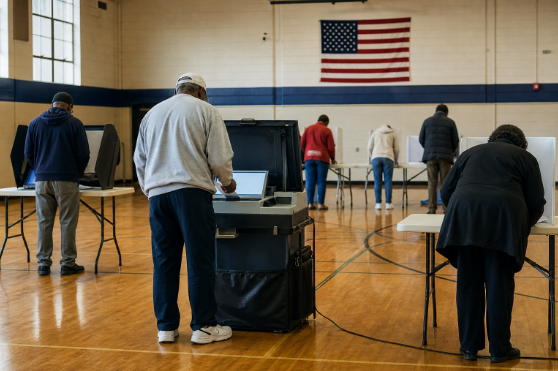
On April 29, 2026, the Supreme Court ruled 6-3, along ideological lines, that Louisiana’s majority-Black congressional district was an unconstitutional racial gerrymander. The ruling, in the case Louisiana v. Callais, effectively gutted what remained of Section 2 of the Voting Rights Act of 1965, which had been used for decades to require states to draw congressional districts that gave Black and other minority voters a meaningful opportunity to elect representatives of their choice. Eight days later, Tennessee’s Republican-led state legislature met in a special session called by Governor Bill Lee at the request of President Trump and passed a new congressional map eliminating Tennessee’s only majority-Black congressional district, the 9th District, which had been based in Memphis. Today, August 6, 2026, Tennessee voters are casting ballots in primary elections for the first time under the new map.
What the Supreme Court Ruled
The case that triggered the redistricting scramble, Louisiana v. Callais, challenged a congressional district Louisiana had drawn to add a second majority-Black seat in the state. That district had itself been ordered by a lower federal court under Section 2 of the Voting Rights Act, which requires that minority voters have an equal opportunity to elect representatives of their choice. The Supreme Court’s 6-3 ruling on April 29 held that the majority-Black district was itself an unconstitutional racial gerrymander, reversing a decades-old framework that had made majority-minority districts a routine tool for protecting minority voting power. The three liberal justices dissented. The ruling opened the door for Republican-led legislatures across the South, and elsewhere, to redraw congressional maps eliminating majority-minority districts that had previously been protected or even required under the Voting Rights Act. Analysts estimated the ruling could allow Republicans to gain between 4 and 19 additional House seats through redistricting across the country ahead of the November 3, 2026 midterm elections.
Tennessee’s Response: The Special Session
Eight days after the ruling, on May 5, 2026, Tennessee Governor Bill Lee called a special session of the Republican-controlled state legislature to redraw the state’s congressional map. The Associated Press reported that Trump described the redistricting effort as part of a national plan to help Republicans hold their slim House majority. The new map passed on May 7, 2026. The change was stark: Tennessee’s 9th Congressional District, centered on Memphis and heavily Black, had backed Kamala Harris for president by 43 percentage points in the 2024 election. The new 9th District, which stretches approximately 250 miles from Memphis east toward the Nashville area while following the Mississippi border, would have backed Trump by 21 percentage points in 2024, a swing of 64 points. Republicans currently hold 8 of Tennessee’s 9 congressional seats. The new map was drawn with the goal of giving Republicans a realistic shot at all 9.
What the New Map Does to Memphis
For more than 30 years, Memphis and the surrounding Shelby County formed the core of a single congressional district — the 9th — that was majority-Black and reliably Democratic. Under the new map, Shelby County is divided among three separate congressional districts that extend outward into predominantly rural, majority-white areas like spokes on a wheel. Memphis voters who were previously united in a single district with a representative accountable primarily to a majority-Black Memphis constituency are now divided among three districts, each of which must also serve large rural populations with different political interests and demographics. A retired postal worker and military veteran told the Associated Press: ‘We only had one district in the whole state of Tennessee, and you don’t even want that to be fair? It’s just terrible.’ A 23-year-old Memphis voter who learned about the map change only after receiving a letter in the mail described it as ‘a drastic change’ and ‘a voter suppression tactic.’
Steve Cohen’s Decision
Representative Steve Cohen has served Tennessee’s 9th Congressional District since January 2007, a tenure of nearly 20 years. Cohen, who is white, has represented a majority-Black district for his entire congressional career — a fact that made him an unusual figure in American politics and one he often cited in discussing his record on civil rights and criminal justice. After the new map was signed into law, Cohen announced that he would not seek reelection in the newly redrawn district. He had served 47 years in public life in total, including stints on the Memphis City Council and the Tennessee state Senate before being elected to Congress. His departure ends a congressional era in Memphis. No sitting Democratic congressman from the old 9th District will be on the general election ballot in November.
Who Is Running Today
The Democratic primary for the new 9th District includes four candidates, with state Representative Justin J. Pearson and state Senator London Lamar as the primary contenders. Pearson, 29, gained national attention in April 2023 when the Republican-led Tennessee House of Representatives voted to expel him and fellow Democratic state Representative Justin Jones from the legislature. Both had participated in a protest on the House floor following a deadly school shooting at a private school in Nashville, in which three children and three adults were killed. Memphis officials reinstated Pearson to his seat within days. He won reelection in August 2023 and announced his congressional candidacy in October 2025. Lamar, a state senator from Memphis who has built a following in local politics, entered the race later, setting up what became the primary contest on the ballot today. On the Republican side, Trump endorsed state Senator Brent Taylor in a four-person primary for the new district.
What the November Election Will Look Like
The Democratic nominee from today’s primary will face the Republican nominee — likely Taylor if Trump’s endorsement holds — in the November 3 general election. The new district lines give Republicans a substantial structural advantage: a district that backed Trump by 21 points in 2024 is not considered competitive under normal political conditions. If Republicans win the new 9th in November, Tennessee will send an all-Republican congressional delegation to Washington for the first time in the modern era. The broader national stakes are significant as well. Analysts estimate that the wave of post-VRA redistricting prompted by the Supreme Court’s April ruling could give Republicans between 4 and 19 additional House seats before the midterms, potentially enough to offset Democratic gains elsewhere and determine which party controls the House of Representatives. Democrats need a net gain of seats to win the House majority. Memphis voters choosing among Democrats today are selecting the candidate who will make that argument in the November general election, in a district redrawn specifically to make it much harder for them to win.