
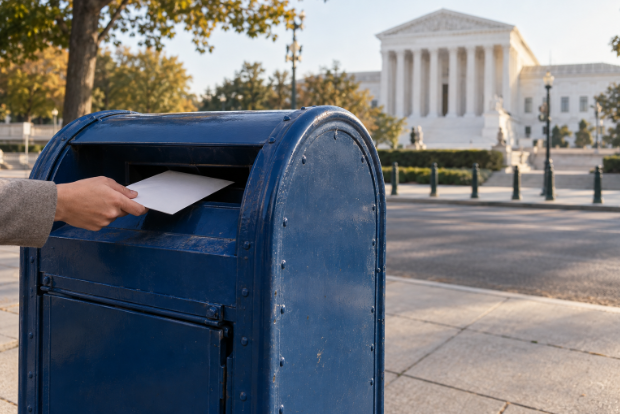
Mail voting in the 2026 election will work the way it always has. That is the plain meaning of a brief, unsigned order the Supreme Court issued Monday night, rejecting the administration’s request to switch on the Postal Service’s mail ballot rule while its appeal proceeds. The justices’ reasoning fit in a sentence: “The Government is unlikely to succeed on the merits of its challenge.” Only Justices Samuel Alito and Clarence Thomas dissented. For readers who have followed this newsletter’s coverage since June, Monday was the ending: after an executive order, a 95 page rule, six months of litigation, five straight merits losses in the lower courts, a whistleblower, a contempt warning, and three emergency trips to the Supreme Court in six weeks, the highest court in the country, with at least four Republican appointed justices in the majority, looked at the administration’s signature election project and said it would probably lose. The ballots already moving through the mail will be delivered under existing law. Tens of millions more will follow them.
What the Court Ordered
The order, docketed as case 26A305, denies the government’s application to stay Judge Indira Talwani’s September 4 preliminary injunction, which blocks the Postal Service rule through the November 3 election. The rule would have let the Postal Service refuse to deliver mail ballots that were not on a state submitted voter list or did not meet new federal envelope and barcode requirements. With the stay denied, Talwani’s injunction stands, and per Votebeat, mail voting in 2026 will largely function as it has in previous elections. The “unlikely to succeed on the merits” formulation matters: this was not a procedural exit like August’s standing ruling. A majority of the Court looked at the substance, the claim that the Postal Service may condition ballot delivery on state compliance with federal requirements, and signaled skepticism. Talwani’s core finding, quoted in her ruling, has now survived every level of review this election cycle: “The court is unaware of, and no party has proffered, any delegation Congress has made that would permit the USPS to regulate election mail.”
The Fine Print: Kavanaugh’s Warning for 2028
The order settles 2026 and deliberately unsettles everything after it. Justice Brett Kavanaugh wrote separately to say there is “at least a fair prospect that the final rule falls within the Postal Service’s statutory authority,” but that “state and local election officials do not have sufficient time to reasonably implement the rule before the elections.” Read carefully, that is a timing vote, not a merits vote: Kavanaugh is telling the administration its mistake was the calendar, not necessarily the concept. The dissenting justices, Alito and Thomas, would have let the rule operate this November. So the honest summary is that voters won this election outright, while the question of whether a future administration can run mail ballots through a federal screening system remains open, with at least three justices signaling varying degrees of receptiveness. The underlying case continues in the First Circuit and the district court, and this newsletter will follow it past November.
How It Ended This Way
The administration lost, in the end, for the most ordinary reason in the record: nothing worked and nobody was ready. A bipartisan group of election officials, including several Republican secretaries of state, told the Court that states lacked the time, money, and in some cases the legal authority to comply, with ballots already mailing in North Carolina and Alabama. The federal portal at the center of the rule was still not operational at the end, after being promised “next week” in two consecutive weeks of court filings. The Postal Service’s own whistleblower had described the system as “secretive, rushed, chaotic, and fundamentally flawed,” warning that its batch sampling design, where one failed envelope rejects an entire mailing, risked “catastrophic failure” for millions of voters; the agency’s inspector general opened an investigation, and the Postal Service never disputed the substance. Postmaster General David Steiner defended the effort as nonpartisan to the end. And the government never produced the thing the entire project claimed to address: in six months of litigation, no court was shown evidence of mail ballot fraud. Talwani said so in August. The Supreme Court’s Monday order is the same conclusion with a longer shadow.
What It Means for Voters
The practical answers, for readers voting by mail this fall. Your ballot will be delivered under your state’s existing rules, carried by the Postal Service as ordinary election mail, with no federal list check and no envelope screening. The roughly one in three American voters who use the mail can request, receive, and return ballots exactly as in past elections. States that voluntarily redesigned envelopes, like North Carolina, simply have compliant envelopes; nothing about their ballots changes. The confusion that election officials warned about, rules changing mid stream with ballots in the trucks, is over for this cycle. What remains in litigation, the purge database case and the underlying appeals, does not touch how your ballot travels this November.
Where Things Stand
The scoreboard closes at zero. On the merits of its mail voting project, the administration went zero for five in the lower courts, and the Supreme Court has now added that it is unlikely to succeed at all. Elsewhere on the docket and the calendar: the challengers’ response in the voter purge database case, the administration’s other pending election application, is due at 4 p.m. today. The Federal Reserve announces its rate decision tomorrow, the moment this month’s economic coverage has been building toward. And the trade war widened overnight: a new American 50 percent tariff on 110 Canadian products, from cheese to furniture to motorboats, took effect at 12:01 this morning, with an outright import ban on Canadian dairy, most alcohol, and motorcycles set for September 29. Forty nine days before the election, the rules of the election itself are finally, mostly, settled. What voters do with them is the part no court decides.