
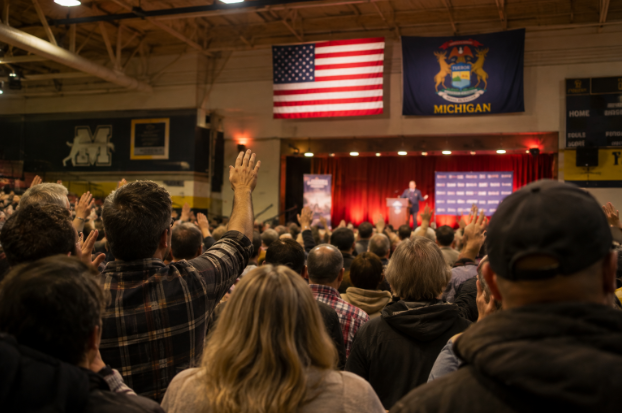
The gym at Cass Technical High School filled Saturday night with news crews broadcasting in multiple languages, which tells you what the country thinks is happening in Michigan. Barack Obama stood with Abdul El-Sayed, the Democratic Senate nominee, and Jocelyn Benson, the nominee for governor, and made an ask that fit in a sentence, vote early, starting now, and send El-Sayed to the Senate. The timing was the message. Saturday was the first day of Michigan’s required statewide in person early voting, and the former president spent it onstage in Detroit after a morning rally in Cleveland. Two weeks ago this page logged Obama’s donor warnings and travel ramp as one of the five tells that the parties believe the map has moved. The tell now has a schedule, and the schedule runs through Michigan.
The race underneath the rally is the reason. Michigan’s open Senate seat sits at the top of the ballot in a contest the national coverage calls a dead heat, between El-Sayed, the progressive who won a bitter August primary, and Mike Rogers, the former congressman whose closing pitch is his direct line to the White House. The money has run lopsided, El-Sayed reported 25.6 million dollars in the third quarter to Rogers’ 6.9, a gap this page logged when the filings posted. And the weekend built its own split screen. The president answered from Port Huron on Sunday night, a rally that leaned into the attacks on El-Sayed’s name and faith with the nominee’s image displayed onscreen, and that put both parties’ biggest draws in one state inside 24 hours. By the watch the feet method this newsletter has run all month, Michigan is the center of the map.
The Detroit arithmetic is specific. NBC’s framing of the race is that it could come down to the city’s substantial Black electorate, and Republican attack ads have worked that seam directly, replaying El-Sayed’s own past criticisms of Obama, that he fell short of delivering change, to peel Black voters toward Rogers. Saturday was the answer ad, delivered in person. The first Black president stood next to the critic, called him as Michigan as it gets, cited the Ann Arbor education and the Michigan upbringing, and waved off the old disagreements as the kind he has with Michelle. Whatever the speech moved, the setting did the strategic work, cameras on a unified ticket in Detroit on the first morning ballots could be cast in person.
The rally’s second job was stitching the primary wound. El-Sayed beat the party’s moderate wing in August, and the establishment’s embrace since has been careful. Saturday it was explicit. Senator Elissa Slotkin, the center left half of the state’s Democratic brand, spoke and told the crowd Michigan believes in electing fighters, making the case that one state can send her kind of Democrat and El-Sayed’s kind to the same chamber. Obama, who called El-Sayed after the primary, lent the full weight Saturday, his first public appearance for the nominee since the nomination. Benson grounded the ticket’s case in a sentence about parents in Traverse City choosing who in the family gets health insurance. The rally read as a party deciding, in public, that the argument is over.
What the attacks are, and what they are not doing, both belong in the record. Rogers’ side and the president have run hard at El-Sayed’s name, his faith and his politics, a town hall confrontation over a Muslim Brotherhood accusation went viral last week, and one Michigan newspaper announced it would no longer seek Rogers’ comment, citing bigoted attacks. Republicans answered Saturday’s rally by calling the nominee an extremist. Rogers himself responded that his campaign has made huge inroads with Detroit’s Black community because we have been there, and that El-Sayed had to bring in a former president because he is not connecting on his own. That is the fight as both sides describe it. The data point that survives the spin is that after months of it, the coverage still calls the race even.
One paragraph of history, stated flatly. If El-Sayed wins, the son of Egyptian immigrants, a physician and former Detroit health director, would be among the first Muslim Americans ever elected to the United States Senate, from the state holding one of the country’s largest Arab and Muslim communities. Both campaigns understand that sentence is on the ballot alongside the candidates, which is part of why the president’s Sunday rally was in Michigan and not somewhere safer. The number that decides it is unglamorous, turnout in Wayne County across nine days of early voting, and that number is public as it accumulates.
The honest accounting on rallies belongs here too. Their measurable effect on votes is modest, Obama’s own midterms as president produced two historic losses, and this page said when cataloging crossover endorsements that a famous name on a stage is not a precinct. What a visit like Saturday’s concretely does is mechanical. It puts cameras on the first day of voting, hands primary scarred Democrats a permission structure to come home, and answers a targeted ad campaign with footage no ad budget buys. Whether it worked is not a matter of opinion for long. Wayne County’s early vote totals post daily, and this week’s numbers against 2022’s are the test.
For Michigan readers the mechanics are the useful part. The required in person early voting window is open statewide now and runs through the final Sunday before the election, every city and township offers at least nine days, mail ballots can still be returned by drop box or clerk’s office, and the state’s ballot tracker shows yours moving from received to counted. A problem found this week is a fix. The same problem found on November 3 is a line and a wait. The guides this newsletter ran on registration and mail voting carry the rest.
So the weekend’s ledger entry writes itself. The opposition’s biggest surrogate spent the first morning of Michigan early voting asking Detroit for one specific thing, and the president answered from Port Huron a day later. Eight days remain, both parties just planted their feet in the same state, and the method holds. Watch where they stand, watch what the early vote does in Wayne County, and keep the two ledgers separate, the speeches, which are claims, and the turnout, which is counted.