
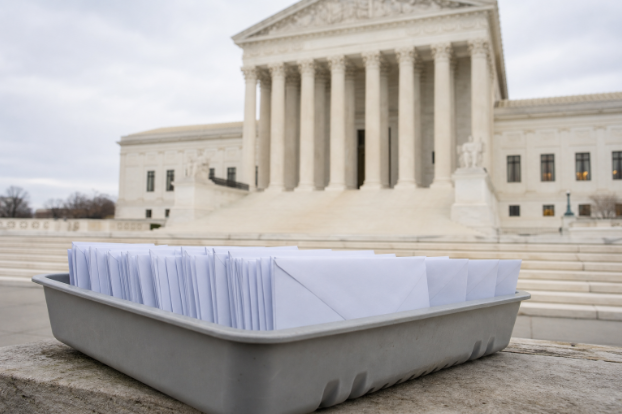
The Supreme Court on Monday opened a path for the Trump administration to begin implementing the president’s executive order restricting mail voting — without deciding whether the order is lawful. The Court’s conservative majority ruled that the 23 Democratic-led states that sued, and won, in the lower courts did not have the legal right to bring the challenge, wiping out the injunction those states had secured. The unsigned order was explicit about what it was not deciding: “The Court’s disposition of this application does not mean that any measure taken by the Government to implement the Order will necessarily be lawful. On that score, time will tell.” The three liberal justices publicly dissented. One major barrier remains — the separate nationwide injunction won by the League of Women Voters, which The People’s Podium covered two weeks ago — and the administration asked the judge Monday night to void it. The clock behind all of it: North Carolina begins sending ballots to overseas and military voters on September 4, with other states following within weeks.
What the Court Actually Ruled
The ruling is procedural, and the distinction matters. The Justice Department’s appeal, filed in late July, did not primarily defend the order’s legality; it argued the states sued too soon and lacked standing — the legal right to bring the case. The conservative majority agreed, which erases the injunction that Judge Indira Talwani granted the 23 states in June and that a federal appeals court upheld in August, without touching her conclusion that the executive branch has no authority to regulate elections. Justice Ketanji Brown Jackson, writing in dissent for the Court’s three liberals, said the ruling “lets another shoe drop in the Kafkaesque nightmare that our precedents have been steadily creating for certain plaintiffs who seek to bring election-related challenges” — a system, in her telling, where the order cannot be challenged before it is implemented, and by the time it is implemented, it is too close to the election to stop. The contrast with the Court’s June mail-ballot ruling is instructive: in Watson v. RNC, the Court upheld state grace periods for late-arriving ballots 5-4 after full briefing and argument. Monday’s action came on the emergency docket, weeks after the administration’s filing and days before ballots go out, with no argument at all.
The One Injunction Left
Monday’s ruling does not, by itself, let the administration proceed. Judge Talwani’s second injunction — issued August 11 in the separate case brought by the League of Women Voters and other voting rights groups, and covering all 50 states — remains in effect, exactly the backstop role this newsletter described when it was issued. The administration moved Monday night to have it voided or suspended in light of the Supreme Court’s ruling, and the standing logic that doomed the states’ case may or may not apply to private plaintiff organizations; that question is now urgent. Additional lawsuits have already been filed, and New York Attorney General Letitia James, calling the decision a “painful setback,” vowed it would “not be the final word.” Election law scholar Derek Muller of Notre Dame put the posture bluntly: “This is just the first inning of a very fast nine-inning game.”
The Machinery Is Already Moving
While the litigation ran, the administration prepared to implement. The executive order, signed in March, directs the government to assemble lists of eligible voters and orders the U.S. Postal Service to deliver mail ballots only to people on those lists. Last week the Postal Service laid out its implementation plan, and Friday’s requirements went further than the order itself: the Postal Service would refuse to send mail ballots from any state that does not comply with the order. That is the mechanism by which a federal executive order would reach into states that never agreed to it — not by changing state law, but by having the federal mail service decline to carry the ballots state law provides for. Dozens of state and local election officials told the Supreme Court that changing the rules now, with preparations underway, would be extreme. David Becker, the former Justice Department attorney who co-wrote a book debunking the 2020 election claims, said the Court had created “pure chaos leading up to the midterm elections, waiting weeks after an administration filing, and just days before mail ballots go out, to completely rewrite the rules.”
The Facts Underneath the Fight
Roughly 30 percent of all ballots in the 2024 presidential election were cast by mail, per federal data — a method popular with voters of both parties, and one the president himself has used. Trump has blamed mail voting, without credible evidence, for his 2020 loss, and has promoted the executive order as a safeguard against noncitizen voting, which is a felony punishable by deportation and which research has consistently found to be vanishingly rare. A 2025 Brookings Institution study found roughly four cases of fraud per 10 million mail ballots cast. The order’s practical effect, if implemented, would not be measured in fraud prevented; it would be measured in whether ballots that state law entitles voters to receive arrive at all — and with what confusion, in which states, on what timeline. Senate Minority Leader Chuck Schumer said Democrats would “fight every attempt to hijack mail-in voting and rig the rules before voters have their say this November.”
Where Things Stand
The sequence from here is compressed. Judge Talwani must rule on the administration’s motion to void the nationwide injunction; new challenges are queued behind it; and North Carolina’s September 4 ballot date arrives in ten days, with other states close behind. Every prior round of this litigation ran through this newsletter’s coverage: the June 25 ruling for the 23 states, the appeals court affirmance, the August 11 nationwide injunction — and now a Supreme Court ruling that undid the first two on standing grounds while explicitly reserving the question that has decided every round below: whether a president can regulate elections at all. The Court’s own words are the fairest summary of where the country’s voting rules stand ten weeks before a national election: on that score, time will tell.