
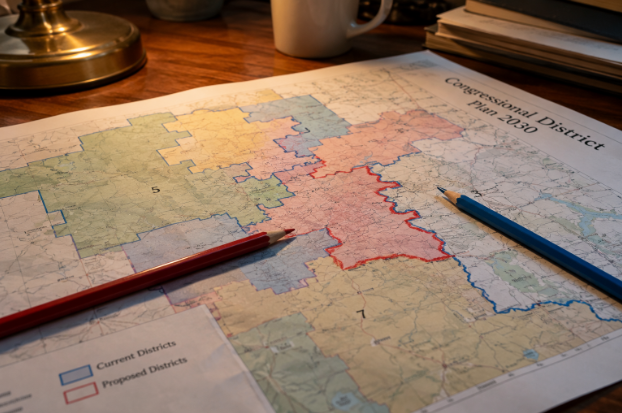
Start with the scale, then the result, because the gap between them is the story. Going into this election, roughly one third of the country’s congressional districts were redrawn, the product of a mid decade redistricting fight President Trump started by pressing Texas to manufacture five new Republican seats, which seven Republican states joined, California answered, the Supreme Court accelerated, and courts in Utah, Virginia and Missouri complicated. The Associated Press has now measured what all of it bought. By its analysis of presidential margins under the new lines, the tipping point seat for House control moved from a district Trump won by 3.1 points to one he won by 4.5. The biggest redistricting war in memory shifted the average battlefield 1.4 percentage points, and the AP’s own conclusion is that it may not be enough to stop Democrats from flipping the chamber anyway.
The neutralization is the first reason why. Texas redrew for five Republican pickups, California answered with a map targeting five Republican seats, and by the AP’s accounting the two effectively canceled. Worse for the architects, the Texas seats are not behaving like the sure things they were drawn to be. Texas’s 35th District was reshaped to favor Trump by 10 points in a seat where more than half of eligible voters are Latino, and with Trump’s standing among Latino voters slipping, Democrats have put more than 2.5 million dollars into holding it since September. A district drawn as a slam dunk that requires defending is a drawn play that broke.
The courts cut in both directions, which this page has tracked all fall. Utah’s Supreme Court, enforcing a voter approved gerrymandering ban, forced a Salt Lake City district that swung 44 points toward Democrats. Missouri’s Republican map, the one this newsletter covered in September when the state briefly had two maps and no answer, got parked by a citizen referendum drive and never reached this ballot. Virginia’s high court blocked the Democrats’ own four seat redraw, and Indiana’s legislature refused Trump’s pressure entirely. Both parties left seats on the table, which is why both are already talking about 2028.
Then there is the change that was not about party math at all, and it deserves plain language. After the Supreme Court’s ruling in Louisiana v. Callais gutted the Voting Rights Act provision that protected majority minority districts, three Southern states dismantled three of them. Tennessee’s 9th is the starkest case. Its nonwhite population share fell from 71 percent to 38, its presidential margin swung 65 points, from a 43 point Harris district to a 21 point Trump one, and its mostly Black voters were spread across neighboring districts. For the first time in decades, every one of Tennessee’s nine congressional districts has a majority white electorate. The AP’s data puts the mechanism in one sentence, the districts that got whiter moved toward Trump, and the ones that got less white moved toward Harris.
The strategists’ real prize may not be new Republican seats at all. It is Democratic money burning on defense. Republicans redrew North Carolina’s 1st District under Representative Don Davis from a seat Trump carried by 3 points into one he would have won by nearly 12, and Democrats have since spent more than 6 million dollars defending it, by AdImpact’s count, money that cannot also attack Republican seats. Multiply that across every Democratic incumbent dropped onto hostile new terrain and the redraw works even where it does not flip anything this year. And the bill has a second installment. In a more neutral year without this cycle’s wind, those same redrawn seats become the Republican path back, which is the map’s quiet gift to 2028.
The scoreboard under the new lines reads 234 districts that voted for Trump in 2024 against 201 that voted for Harris, with 179 million people living in Trump districts and 155 million in Harris ones. That is the structure. Against it stands the environment, and the arithmetic of this fall says the environment is currently worth more than 1.4 points. A map tilt decides close years. The evidence of the last month, the money retreats, the private concessions, the record early turnout, suggests the parties themselves doubt this is a close year. Thirteen days from now, the map and the environment finally take the same test.
The honest accounting cuts both ways and should. California’s counter map is a gerrymander by any plain definition, the only Democratic enacted redraw of the cycle, and this page’s standard is the arithmetic, not the team drawing the lines. Courts blocked Democrats in Virginia just as they forced Republicans backward in Utah. What the data does not distribute evenly is the racial ledger. The districts erased under Callais were majority minority ones, the voters cracked and spread were mostly Black, and that followed directly from a Supreme Court ruling, not from any single legislature’s cleverness. Partisan gerrymandering is an old American sin practiced by both parties. Erasing protected districts is this cycle’s new one.
The reader’s move takes one minute and matters more than usual. Because a third of districts changed, millions of people are now in a different district than the one they voted in last time, with a different ballot and possibly different candidates, and many do not know it. The AP’s piece includes an address lookup showing your old and new lines, your state’s election site has the official version, and the sample ballot tools our registration and mail guides pointed to will show you the race you are actually in. Check before you vote, not after, because the district you think you live in may not be the one on your ballot.
So the ledger entry for the redistricting war reads like this. One third of the map redrawn, three protected districts erased, two mega states canceling each other, courts pushing both directions, and a net shift of 1.4 points that may be swallowed whole by the year it was built to survive. The lines were drawn so politicians could pick their voters before the voters picked them. In thirteen days the voters get their turn anyway, on whatever lines they were handed, and the surest way to use that turn well is to know which district is actually yours.