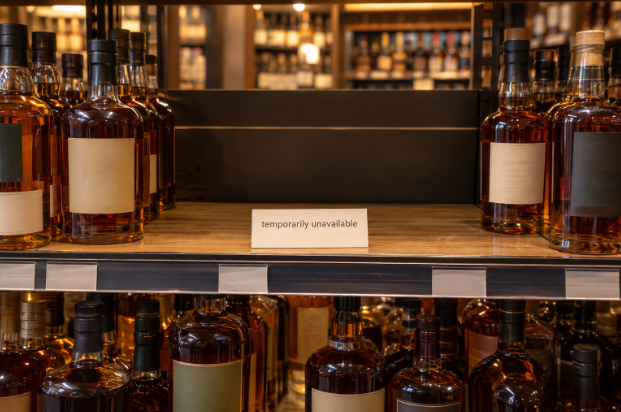
At one minute past midnight Tuesday, the United States switched on a trade weapon it has never used in the modern era. Nearly a billion dollars a year in Canadian goods are now barred from entering the country outright. Most Canadian liquor. A slice of the dairy trade, down to whey, the milk byproduct that runs through American food manufacturing. Motorcycles built in Quebec. This is not another tariff, and the difference matters for the arithmetic. A tariff at least collects money at the door and lets the product through at a higher price. A ban collects nothing. The bottle never reaches the shelf, the government books zero revenue, and the cost shows up as an empty spot where a choice used to be.
The legal machinery is the story underneath the story. In February the Supreme Court rejected the president’s use of emergency economic powers for sweeping tariffs, so in July his lawyers went digging and came back with Section 338 of the Tariff Act of 1930, the Depression era statute that carries the most infamous tariffs in American history. The provision lets a president declare, as a fact, that a foreign country discriminates against American commerce, then impose duties up to 50 percent by proclamation. It sat on the books for 96 years without ever being used to impose a tariff. Congressional researchers confirmed as much in March. On July 20 Trump used it against Canada, 50 percent on roughly 20 billion dollars of goods across autos, alcohol and dairy. And the statute holds one more rung. If the president decides the discrimination continues, he can stop the goods entirely. In September he climbed it, signing proclamations that converted the 50 percent tariffs on alcohol, dairy and motor vehicles into flat bans effective Tuesday morning.
The count comes to about 967 million dollars of imports a year, by the American Action Forum’s math on 2025 trade data, and 87 percent of it is alcohol. Canadian whisky, beer, ice wine. The rest is the dairy list and motorcycles, and Bombardier Recreational Products confirmed its Spyder and Canyon three wheel machines are now excluded from the American market. These products were already paying the 50 percent tariff. As of Tuesday they cannot enter at any price, and shipments that try can be seized under customs law. Against 880 billion dollars in annual two way trade, a billion is a ripple, and that is partly the point. This round was built to send a message, not to move the trade balance.
The stated reason is discrimination, and the details deserve a plain reading. The alcohol ban answers Canadian provinces that pulled American liquor off their government run store shelves, which they did in response to his tariffs. So the ban punishes the counterpunch. The dairy finding says Canada administers its cheese quotas in ways that favor European producers, and the auto finding attacks a quota system that encourages building cars in Canada. What the victim framing skips is the ledger. On dairy, the United States has run a trade surplus with Canada averaging about 600 million dollars a year since 2021. The country described as shut out is the one selling more.
The sequence that got here has the rhythm of a schoolyard. His 50 percent tariffs took effect in August after talks collapsed. Prime Minister Mark Carney matched them dollar for dollar on about 19 and a half billion dollars of American goods, the response Carney was elected promising. The ban is the punishment for the matching. Trump said Monday he expects a fair deal within weeks and that Ottawa will cave. Canada’s trade minister, Dominic LeBlanc, said his government is not waiting by the phone, and his office greeted the ban Tuesday with one flat sentence taking note of it. Carney, meanwhile, is doing the quieter thing that lasts, steering a country that sends more than 70 percent of its exports here toward other buyers.
Now the honest accounting of who pays, because it is not Ottawa. American importers and distributors lose product lines they built businesses on. Bars and liquor stores lose stock they cannot legally restock, and where supply dies, prices on the remaining shelf climb. Food manufacturers lose a whey supply chain. Dealers lose a motorcycle brand. And the American liquor industry now loses twice, because its own bottles are still off Canadian store shelves in retaliation for the tariffs that started this. Kentucky distillers lost their best foreign shelf, and the ban does not put a single bottle back. It just takes Canadian rye away from the Americans who drink it. Two governments are trading punches, and the bruises are landing on customers in both countries.
Step back and the constitutional pattern is familiar from this month’s other stories. A president loses at the Supreme Court, reaches deeper into the drawer, and finds a statute nobody has tested, one that lets him decide the facts himself and act by proclamation, no vote, no hearing, no waiting. Trade lawyers call Section 338 a blank canvas because no court has ever reviewed it. Scholars who have read it closely say it only authorizes measures that offset actual harm, a limit these proclamations may blow through, and American importers are the likely plaintiffs. If the bans stand, any future president can erase any country’s products from American stores by signature. It is the same play the White House is running on press passes, act first, make the courts chase.
Nobody involved expects a quick end. The trade attorney Patrick Childress, formerly of the trade representative’s office, says the standoff will likely run months, not weeks, because neither the tariffs nor the bans cause enough pain to force either government back to the table. Analysts expect Canada to answer again. And the timing writes its own caption. Days after the White House rolled out a state dinner for Xi Jinping, it banned whiskey from the ally that shares our longest border. The administration is softer on the country it calls an adversary than on the neighbor it calls a friend.
So watch three things. Canada’s next list. The first importer lawsuit against a statute with no case law. And the shelf at your own store, because that is where a ban becomes visible, one missing bottle at a time, with grocery and liquor prices already carrying seven months of tariff math into the holidays. The trade war was never on the ballot, but it is in the cart, and the people pushing the cart vote.