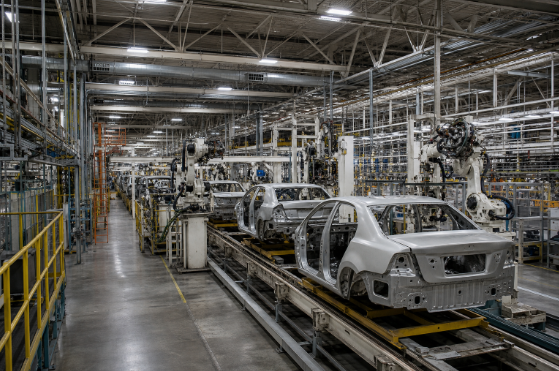
On July 27, 2026, President Trump held a rally at the General Motors Proving Ground in Milford, Michigan. He told the crowd that ‘Michigan is thriving,’ that ‘car companies are doing better than they’ve ever done,’ and that all of it was happening ‘all because of Trump.’ According to data from the U.S. Bureau of Labor Statistics, Michigan has lost 8,300 manufacturing jobs since Trump announced his ‘Liberation Day’ tariffs on April 2, 2025 — the sweeping import levies that the administration said would revive American industry. Auto parts manufacturing alone is down approximately 4,000 jobs through June 2026 compared to the same period a year earlier. Business sentiment in Michigan is at its lowest point in more than two decades, worse than during the Great Recession. The automakers have announced new U.S. investments, but most of the production shifts are not scheduled to begin until next year or later. The Michigan workers who attended the rally described the economic pain as real.
What the BLS Numbers Show
The Bureau of Labor Statistics tracks monthly employment by sector at the state level. Michigan’s manufacturing employment has fallen by 8,300 jobs since April 2025, when Trump signed the Liberation Day tariffs. The auto parts sector, which is central to Michigan’s manufacturing base, has shed roughly 4,000 of those jobs through June 2026. A July 22, 2026 study by the Economic Policy Institute found that the 2025 tariff actions cost Midwest manufacturing an estimated 41,700 jobs in total, with Michigan alone accounting for approximately 12,400 of those losses when accounting for ripple effects through the regional supply chain. The Economic Policy Institute, or EPI, is a nonpartisan research organization that analyzes the labor market impact of trade and economic policy. The BLS data and the EPI study use different methodologies and produce different totals, but both point in the same direction: Michigan manufacturing employment has declined since the tariffs took effect, not grown.
The Tariff and the Rebate Extension
The Liberation Day tariffs imposed a broad set of import duties on goods from U.S. trading partners. For the auto industry, the specific pressure came from a 25 percent tariff on imported vehicles and auto parts that took effect in April 2025. Because the U.S. auto industry relies heavily on parts that cross international borders multiple times before a vehicle is assembled, the tariffs immediately raised production costs for vehicles assembled in the United States. To soften that impact on domestic assembly, the administration created an auto parts tariff rebate program that allowed automakers to recover 3.75 percent of the sales price of each domestically assembled vehicle as an offset against the tariffs paid on imported parts. The rebate was described by the administration as a short-term bridge intended to give manufacturers time to shift production to the United States — with an original sunset through 2027. In October 2025, Trump extended the rebate program through 2030. The extension was not accompanied by any announcement of new conditions or milestones manufacturers would need to meet in exchange for the longer timeline.
Michigan’s Supply Chain Problem
No state in the country is more economically intertwined with Canada than Michigan. The automotive supply chain that runs through Michigan and Ontario, Canada has been built over decades under integrated trade arrangements: parts routinely cross the Detroit River or the Ambassador Bridge multiple times before a car is finished, with each crossing now subject to tariffs. Trump chose not to renew the United States-Mexico-Canada Agreement, known as USMCA, the trilateral trade deal that governed North American trade and set rules for automotive content. The White House has said the current version of USMCA is ‘not sufficiently beneficial for the United States.’ In July 2026, Trump announced plans to impose 50 percent tariffs on most Canadian goods — tariffs that, if implemented, would directly raise costs on the Canadian-sourced parts and materials that flow into Michigan plants every day. The Gordie Howe International Bridge, a new Canada-U.S. crossing built specifically to handle cross-border auto industry freight, opened during the middle of the trade dispute. Canada canceled the joint opening celebration, citing Trump’s tariff threats.
What Michigan Business Owners Say
The Michigan Future Business Index, a regular survey of Michigan business owners, reported in 2026 that economic sentiment in the state had fallen to its lowest level in more than 20 years — lower than at any point during the 2008-2009 Great Recession, a period during which General Motors and Chrysler declared bankruptcy. In the most recent survey, 49 percent of Michigan business owners said the tariffs had increased consumer prices in their market. Thirty-seven percent said the tariffs had decreased their profits. The survey results are consistent with broader national data: Federal Reserve Chair Jay Powell said in March 2026 that tariffs were adding between half a percentage point and three quarters of a percentage point to the national inflation rate, and that the elevated uncertainty was complicating the Fed’s ability to manage interest rates. In Michigan, where the auto industry is the economic anchor, the combination of higher parts costs, reduced consumer purchasing power, and supply chain disruption has created compounding pressure.
The Announced Investments
The administration has pointed to a series of announced manufacturing investments as evidence that the tariff strategy is working. General Motors announced in June 2025 a $4 billion plan to shift some production currently done in Mexico to the United States, with new U.S. jobs expected to begin materializing ‘next year.’ Ford and Stellantis, the company that produces Jeep, Ram, and Dodge vehicles, made similar announcements on similar timelines. Toyota announced a $3.6 billion investment to move production of its Tacoma pickup truck from Mexico to a plant in Texas over approximately four years. These announcements are real. They reflect decisions that the tariffs appear to have influenced. But most of the production shifts have not yet begun, and the jobs tied to those announcements have not yet been created. The lag between an announced investment and the jobs it produces is typically measured in years, not months. In the interim, the BLS data captures what has happened to employment, not what the companies have said they plan to do.
What the Rally Looked Like
The July 27 rally at the GM Proving Ground drew a crowd of Trump supporters in a state the president carried in 2024. The AP reported that the mood at the rally was complicated. Supporters who acknowledged economic pain framed it in terms of patience: ‘no pain, no gain’ and ‘short-term pinch’ were phrases reporters heard. One attendee who said she lives on Social Security, receiving $1,100 per month, told the AP that Trump had ‘forgotten about the people on a fixed income.’ Bernie Porn, a Michigan-based pollster with decades of experience tracking the state’s political mood, said of the president’s claims about the Michigan economy: ‘What planet are you on?’ The GM Proving Ground, where the rally was held, is an automotive testing facility — a setting chosen to associate Trump with Michigan’s auto industry. The facility itself employs engineers and test drivers, not assembly line workers, and is not a plant where production jobs are gained or lost.
What Happens Next
The administration’s argument is that the tariffs will produce manufacturing job growth over time, once the announced investments come online and once the new tariff regime has reshaped supply chains. That argument may prove correct — or it may not. The BLS will release updated state-level employment data for July 2026 in late August. The EPI and other researchers will continue tracking the job impact of the tariff policy as it continues. The 50 percent Canada tariff, if finalized and implemented, would add a new layer of cost pressure on a Michigan manufacturing sector that is already absorbing elevated input costs. The midterm elections are November 3, 2026. Michigan is a swing state with multiple competitive congressional districts, and its economic trajectory is likely to be a significant factor in those races. The data so far is not what was promised.