
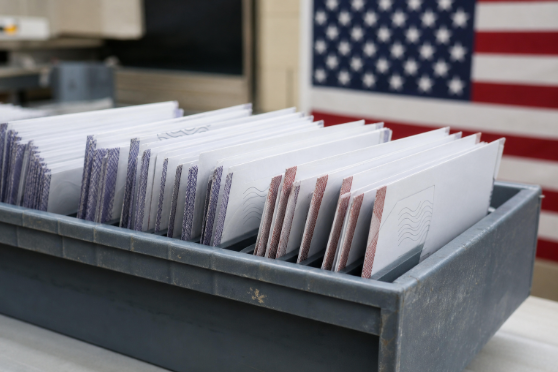
This past weekend, the First U.S. Circuit Court of Appeals — based in Boston — upheld a lower court’s injunction blocking President Trump’s executive order on mail-in voting. The order, signed in March 2026, directed the Department of Homeland Security to compile what it called State Citizenship Lists of eligible voters and required the U.S. Postal Service to deliver mail ballots only to people whose names appear on those lists. A federal district court had already found key provisions of the order unconstitutional. The Trump administration appealed, and the First Circuit declined to lift the injunction. The order remains blocked in the 23 states and the District of Columbia that sued to stop it ahead of November’s midterm elections. The Justice Department said it is reviewing all options and remains confident the executive order will ultimately be upheld.
What the Executive Order Does
The executive order has three main components. First, it directs the Department of Homeland Security, working with U.S. Citizenship and Immigration Services and the Social Security Administration, to build a federal database of U.S. citizens eligible to vote in federal elections. This database would be compiled using federal records rather than state voter rolls. Second, it directs the U.S. Postal Service to deliver mail ballots only to individuals whose names appear on those federal citizenship lists. Under existing law, states administer their own voter rolls and determine who is eligible to receive a mail ballot. The executive order would effectively give the federal executive branch a veto over which voters receive ballots by mail. Third, the order requires that mail ballot envelopes carry unique barcodes so individual ballots can be tracked. It also threatens to withhold federal funding from states that do not comply with its requirements.
Why Courts Found It Problematic
The Constitution assigns to states and Congress — not the president — the authority to set rules for federal elections. Article I gives Congress the power to regulate the time, place, and manner of congressional elections. The Tenth Amendment reserves powers not granted to the federal government to the states. For more than two centuries, states have administered voter registration, maintained voter rolls, and determined the rules for absentee and mail-in voting. The twenty-three states and the District of Columbia that filed suit argued that no provision of the Constitution and no federal statute gives the president the unilateral authority to override those rules through an executive order. The district court agreed, finding key provisions of the order unconstitutional and issuing an injunction to prevent its enforcement. The First Circuit, reviewing that injunction on appeal this weekend, declined to lift it, rejecting the administration’s argument that it should be allowed to proceed while the legal challenge works through the courts.
Who Sued and Why
Officials from 23 states and the District of Columbia filed suit after the executive order was signed in March 2026. The plaintiffs include states with large mail voting populations and states whose election administrators argued the order would create significant logistical problems in the months before a major election. Mail voting has expanded substantially across the United States over the past decade. In many states, a significant share of voters cast ballots by mail, and election administrators have built systems, timelines, and procedures around the current rules. The order would require the Postal Service to cross-reference its ballot delivery operations against a newly created federal database before delivering ballots, a process that does not exist and could not be built, tested, and deployed in time for the November 3 midterm elections. Critics also raised concerns that a federal citizenship database built on government records would inevitably contain errors that would result in eligible voters not receiving ballots they are legally entitled to.
The Federal Funding Threat
The executive order does not rely solely on persuasion. It includes a provision threatening to withhold federal funding from states that do not comply with its requirements. This type of funding condition — using federal money as a lever to compel states to adopt federal policy preferences — has its own legal history and its own set of constitutional limits. The Supreme Court has held that while Congress can attach conditions to federal funding, those conditions must be clear, must be related to the purpose of the funding, and must not be so coercive as to amount to forcing states to comply rather than offering them a genuine choice. Whether the president acting alone, without congressional authorization, can impose such conditions on states through an executive order raises additional constitutional questions that have not yet been fully litigated in this case.
How This Fits a Broader Pattern
The mail voting executive order is part of a series of federal actions that have sought to reshape how elections are administered in the United States. In July 2025, Congress passed and Trump signed the Safeguard American Voter Eligibility Act, known as the SAVE Act, which requires documentary proof of citizenship to register to vote in federal elections. On July 9, 2026, Trump fired all three remaining commissioners of the U.S. Election Assistance Commission, the independent federal agency created by Congress after the 2000 election to support states in administering elections and certifying voting equipment. That agency has had no members since. Earlier this month, the Department of Justice demanded that the state of New Jersey hand over the personal information of approximately 6,600 noncitizens who had been accidentally registered to vote due to a motor vehicle software error — and used that demand to renew its request for the state’s entire private voter database. The pattern across these actions is the federal executive branch seeking, through a combination of legislation, executive orders, agency actions, and law enforcement demands, to gain significantly more control over an election system that has historically been administered primarily by states.
What Happens Next
The Justice Department said after the First Circuit’s ruling that it is reviewing all options. Those options include seeking review before the full First Circuit, petitioning the Supreme Court to lift the injunction, or continuing to litigate the underlying case while the injunction remains in place. The administration has said it remains confident the order will ultimately be upheld. The November 3 midterm elections are approximately 14 weeks away. Mail ballot applications, printing, and distribution timelines mean that any federal action to implement the order’s mail ballot restrictions would need to move quickly to affect the election. The injunction as currently written blocks enforcement in the 23 states and the District of Columbia that are party to the lawsuit. A small number of states, primarily those that do not offer broad mail voting, are not covered by the current injunction.