In the Oval Office on Tuesday, with a reporter asking about consumer prices, President Trump said something that is going to be difficult to explain to every American household paying 4.2 percent more for everything than they were a year ago. “You know what I really love? I love the inflation.” He went on to say prices would come down like a rock once the war with Iran ended and the Strait of Hormuz reopened.
The Bureau of Labor Statistics released the May Consumer Price Index on Thursday morning. Inflation came in at 4.2 percent year over year, the first time it has been above 4 percent since 2023. One year ago the same number was 2.4 percent. It has nearly doubled in twelve months.
The Quote in Context
Trump’s comment did not come unprompted. He was asked directly about rising consumer prices and whether Americans were feeling the effects of his economic policies. He acknowledged inflation was real, attributed it almost entirely to the ongoing conflict with Iran and the disruption of oil shipments through the Strait of Hormuz, and predicted the numbers would reverse quickly once the conflict ended.
The war with Iran and the Hormuz closure are real drivers of the energy spike. That part of his explanation is supported by the data. The rest of the inflation picture is more complicated.
What the Numbers Actually Show
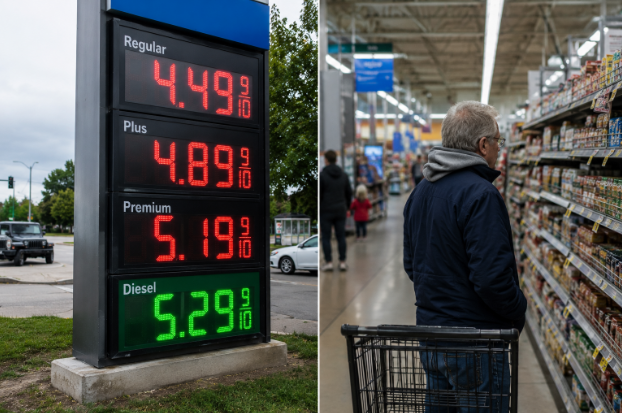
Energy is up 23.5 percent year over year, the largest driver of the headline number and the category most directly tied to the Iran conflict. Gasoline, fuel oil, and electricity costs are all substantially higher than they were twelve months ago. If you drive to work, heat your home, or run any business that depends on shipping or transportation, that number is not abstract.
Outside energy, prices are also moving in the wrong direction. Food is up 3.1 percent. Shelter, meaning rent and the equivalent cost of owning a home, is up 3.4 percent. Apparel is up 4.8 percent. Core inflation, which strips out food and energy to measure underlying price pressure, came in at 2.9 percent, still above the Federal Reserve’s 2 percent target.
Those categories move more slowly than energy and they do not reverse quickly when a war ends. They are driven by housing policy, supply chains, labor markets, and what the federal government is doing to the cost of imported goods. The May report shows price pressure across the entire economy, not just at the gas pump.
The Wage Problem
The price increases are outrunning what workers are making. Real average weekly earnings fell 0.7 percent year over year in May, meaning the average American worker’s paycheck bought less last month than it bought in May 2025. It is the second consecutive month that inflation has outpaced wage growth.
Nominal wages have not stopped growing. But when prices rise faster than wages, the practical effect is a pay cut. Households are not spending more because they are earning more. They are spending more because everything costs more.
What Trump Said and What the Data Does Not Support
Trump is correct that the Iran war is a significant driver of energy prices and that energy can fall quickly if the conflict resolves. That is how energy markets work. The volatility runs in both directions.
What he did not address is shelter, food, apparel, or the underlying core rate. Those categories are not driven by the Strait of Hormuz. Economists and trade analysts have pointed to the administration’s own tariff policies, which have raised costs for imported goods across dozens of categories, as a contributing factor to the persistent inflation in non-energy sectors. The tariffs did not come up in the Oval Office.
Sixty-three percent of Americans disapprove of Trump’s handling of the economy, according to recent polling. A May CPI of 4.2 percent, a three-year high, with real wages falling for the second straight month, is not the kind of data that moves that number in a better direction.
What Comes Next
The Federal Reserve has been holding interest rates steady, watching inflation data before deciding whether to cut or hold. A 4.2 percent print will make a summer rate cut significantly less likely. Higher rates make mortgages more expensive, car loans more expensive, and business borrowing more expensive. The inflation problem does not stay contained to the grocery store. It compounds.