
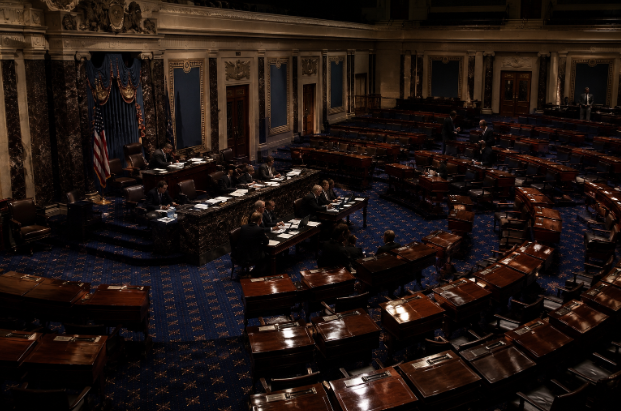
The Senate voted 52 to 47 Thursday morning to pass a $70 billion immigration enforcement bill that funds ICE and Border Patrol through the end of the Trump administration. The vote came after 18 straight hours of procedural votes. One Republican, Lisa Murkowski of Alaska, voted with Democrats in opposition. Every other Republican voted yes.
Buried inside the bill, surviving every attempt to remove it, was a $1.776 billion fund with no legal precedent, no independent oversight, and no restriction on who can receive money from it. Trump’s own attorney general controls it. And that attorney general was just nominated permanently this week.
What the Bill Actually Funds
The funding breakdown is significant. The bill allocates $38.6 billion to ICE, $22.6 billion to Border Patrol, $5 billion to the Department of Homeland Security, and $108.5 million for child exploitation investigations. The money is locked in through the end of Trump’s term, giving his administration a three-year financial runway to expand deportation operations without returning to Congress for additional appropriations.
The bill now goes to the House, where leadership is expected to take it up next week and send it to Trump’s desk.
What the Anti-Weaponization Fund Is
In May, the DOJ announced a settlement of Trump’s personal $10 billion lawsuit against the IRS over the leak of his tax returns. As part of that settlement, Trump agreed to drop the lawsuit in exchange for a formal apology and no personal payment. Instead, $1.776 billion in taxpayer money was placed into a new fund called the Anti-Weaponization Fund.
The fund’s stated purpose is to compensate Americans who claim the federal government was weaponized against them. In practice, the people who would qualify include January 6th defendants, conservative activists, and others who filed complaints alleging political targeting. The fund is administered by a five-member commission appointed by the attorney general.
That attorney general is Todd Blanche. He was Trump’s personal defense lawyer before joining the DOJ as deputy. He was elevated to acting attorney general in April after Pam Bondi was fired for failing to pursue Trump’s perceived enemies aggressively enough. This week Trump announced he will nominate Blanche permanently. Blanche’s commission will now control $1.776 billion with no meaningful independent oversight.
Ninety-three House Democrats filed a legal brief calling the arrangement a specter of corruption unparalleled in American history. PolitiFact found the fund lacks legal precedent. Senator Elizabeth Warren called it a $1.7 billion slush fund for Trump’s hand-picked stooges to hand money to January 6th insurrectionists and his political allies.
The Republicans Who Said No and Then Said Yes
The most striking moment of the vote-a-rama was not the final tally. It was what happened to Senator Thom Tillis of North Carolina in the 18 hours before it.
Tillis, who is retiring at the end of this term, introduced an amendment to redirect the $1.776 billion away from the Anti-Weaponization Fund and toward fraud enforcement. Twelve other Republicans joined him. He told reporters directly: he would not vote for the bill if it included the fund. That was his stated position going into the vote.
The amendment failed 15 to 84. Democrats largely voted against it too, arguing that the money should be eliminated entirely rather than redirected. And then, after 18 hours, Tillis voted yes on final passage anyway.
He was not alone. Twelve Republicans had voted with him to challenge the fund. All of them voted yes on the final bill. The fund survived without a single structural change.
What This Means
Republicans built a narrative around this bill: it was about securing the border, funding law enforcement, and protecting the country. The Anti-Weaponization Fund was a complication, a side issue, something leadership promised to deal with. Tillis tried to deal with it. He failed. Then he voted for the bill that contained the thing he said he could not vote for.
The result is that the Senate, in a single bill, appropriated $70 billion for immigration enforcement and handed Trump’s personal attorney general control of a $1.776 billion fund to distribute to political allies. There is no independent review. There is no congressional oversight mechanism in the bill. The commission reports to Blanche, and Blanche reports to Trump.
The House votes next week.