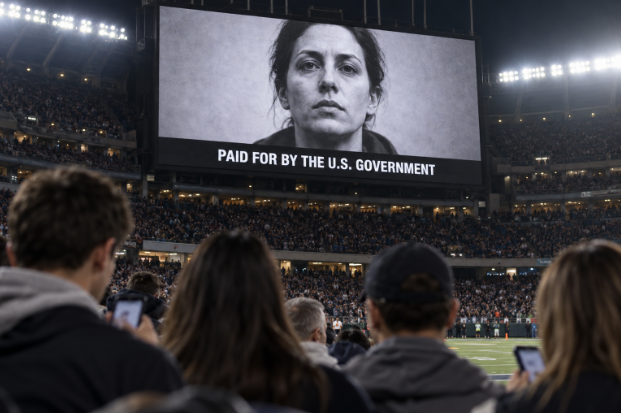
The video is the same one. Black and white, President Trump walking down a hallway, his voice promising that this is the final battle, that we will demolish the deep state, expel the warmongers, cast out the communists, Marxists and fascists, rout the fake news media and liberate America from these villains once and for all. His own campaign released it during the 2024 race, and Time reports the original closed with fine print naming Donald J. Trump for President 2024, Inc. On Sunday it aired during NFL football on Fox. The closing seconds with the campaign logo and a number to text are gone, CNN found, and a new line appears at the end instead: paid for by the U.S. government. Nothing else about the ad needed to change.
On Friday we told you about the first of these spots, a 30 second montage set to a song called Love Me, and the number attached to it was 14,000 dollars, AdImpact’s logged airtime when the AP surfaced it. Treat that figure as a fossil. By the weekend the same tracker put the Love Me buy at nearly 920,000 dollars, with airings during CBS’s Face the Nation and college football, and the final battle spot had cost more than 362,000 dollars on its own, running in two NFL windows on Fox, the Commanders and Seahawks game and the Panthers and Browns game, and on Fox News Sunday, per AdImpact data reported by CNBC. That is more than 1.2 million dollars across two tracked ads in five days, and a jump from niche conservative cable into the broadest inventory American television sells.
The catalog is growing too. AdImpact has now captured three distinct government funded spots: the Love Me montage, which flashes largest tax cuts in history and reigniting American manufacturing over pictures of the president; a minute of scenic Mount Rushmore footage over Trump’s Fourth of July anniversary speech there, his voice declaring that never before has any nation celebrated so magnificent a triumph as this one; and the final battle rerun. CBS News described another: a spot recounting the capture of Nicolas Maduro, featuring the president and his top Cabinet officials, government produced, placed through an ad agency, in 30 and 60 second versions. The singer behind the first ad’s soundtrack, JMSN, says nobody asked him, posted that he would never authorize his music for any political agenda or campaign, and is consulting lawyers. When the White House defended the first spot, its statement used the word announcements. The plural was not a slip. It was a schedule.
The newest ad deserves a pause for what it says under a government payer line. CNN traced the audio to Trump’s 2023 Veterans Day speech and the video to a post on his own Truth Social account during the campaign. The deep state it promises to demolish is the federal workforce the president directs. The sick political class it vows to throw off includes the Congress that appropriates the money paying for the airtime. The fake news media it pledges to rout includes reporters this government banned from the White House this month until a judge restored their passes. A campaign committee can buy that message with donor money. Whether the treasury can is the question every objection this weekend circles.
The White House answered on Friday with a formal release titled Presidential Public Service Announcements Are Nothing New. The announcements are very clearly not campaign ads, it argues; President Trump is not on the ballot and there is no call to action. The precedent list starts reasonably, a Bush campaign explaining the new Medicare drug benefit, Obama’s insurance enrollment push, Biden’s We Can Do This vaccination drive. Then it keeps going, to Woodrow Wilson’s Committee on Public Information and Franklin Roosevelt’s Office of War Information, the government’s World War propaganda bureaus, cited by name as precedent. The Smithsonian article the release links for Wilson’s office has propaganda in its headline. And every program on that list was selling something the government offered its citizens, a drug benefit, an insurance exchange, a vaccine, a war effort. None of them was the sitting president’s own campaign ad, aired again with the payer line changed.
The law involved is not exotic. Annual appropriations bills have banned spending public money on publicity or propaganda since the 1950s, and the Government Accountability Office reads that ban to cover material that is purely partisan, self aggrandizing or covert. Time notes the GAO found a Bush era campaign crossed that line. The Hatch Act runs on a second track: the president himself is exempt, but the White House employees who produced and placed these spots arguably are not, Representative Jamie Raskin’s argument since the first ad surfaced. Public Citizen has filed complaints with the GAO and the Office of Special Counsel asking for an investigation. And Raskin said the quiet part on Friday: this close to the election, Democrats can write complaints of protest and expose it, but we’re not going to be able to stop it. The offices that would enforce any of this answer to the administration being complained about.
So the record of objections is worth preserving, and it runs the width of the aisle. Senator John Kennedy of Louisiana said on CBS on Sunday that he does not think any public official, including President Trump or Kristi Noem or John Kennedy, should spend public money on private ads for themselves. Noem is there for a reason: NBC News reported her 220 million dollar border ad campaign was a factor in her March firing from DHS. Kentucky’s Thomas Massie posted that using taxpayer dollars to run ominous campaign ads of the president has been done before and is completely legal, in banana republics. Thom Tillis’s line from the first ad, that it feels like Viktor Orban, still stands. Senator Maggie Hassan told the chief of staff the ad appears to run afoul of federal propaganda prohibitions, and the senior Democratic appropriators, Murray, Reed, DeLauro and Hoyer, called it the sort of government propaganda one might expect in North Korea and demanded it come off the air. Their letter went out Thursday. The newest spot ran through Sunday’s NFL slate anyway.
Friday’s piece carried the honest caveats, and they still hold. Incumbents have always promoted themselves with public money; House franking mail cost 44 million dollars in the 2024 cycle. Here is what five days changed. The 14,000 dollar curiosity became a seven figure campaign of multiple spots buying professional football. The plural became a catalog. And the newest entry ends the argument by analogy, because it is not a spot that resembles a campaign ad. It is a campaign ad, the president’s own, with the payer line swapped from his campaign committee to the United States government. The White House’s best defense, no candidate and no call to action, restates the test instead of passing it. Self aggrandizement is the category the ban names, and this is the president’s campaign creative billed to the public.
Add it to the ledger. A benefits database aimed at the voter rolls. A detainee locator switched off. Press passes killed until a judge intervened. A mail ballot rule blocked with a contempt warning attached. On Friday, a fine print line on one small ad. By Sunday, the president’s own campaign spot running in NFL ad breaks on the public’s tab, while the complaints route to offices the administration controls and the demand letters become part of the record. The state is advertising for itself five weeks before it counts the votes. One slot is still not for sale, and no fine print attaches to it. November 3. Thirty six days.