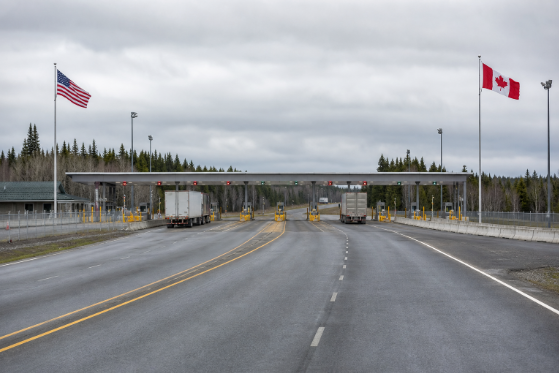
On July 20, 2026, President Trump signed three proclamations imposing 50% tariffs on a wide range of Canadian goods, targeting automobiles, alcohol, and dairy products. The tariffs are imposed under Section 338 of the Tariff Act of 1930, a rarely invoked Depression-era law that allows the president to penalize countries deemed to be discriminating against American commerce. There is no public record of Section 338 being used since 1949. The tariffs are set to take effect 30 days after signing, on or around August 19, 2026. They apply even to Canadian goods that would otherwise be protected under the United States-Mexico-Canada Agreement, the free trade deal Trump negotiated during his first term as president. Canada is the largest trading partner of the United States. Three days before signing the proclamations, Trump posted on Truth Social threatening to add additional tariffs on Canada specifically because of wildfire smoke drifting south across the border from Canadian fires.
What Section 338 Is
Section 338 of the Tariff Act of 1930 is a retaliatory trade provision that allows the president to impose additional duties of up to 50% on imports from countries the president determines are discriminating against American commerce. The law was written during the Smoot-Hawley Tariff era, a period of aggressive American protectionism that most economists credit with worsening the Great Depression by triggering retaliatory tariffs from trading partners worldwide. Section 338 sat largely unused for decades. There is no public record of the provision being invoked since 1949, a span of 77 years. Its use against Canada on July 20, 2026 marks the first time the law has been applied in the modern era. Unlike many of the tariff authorities Trump has previously cited, Section 338 caps the additional tariff at 50%. Trump signed three separate proclamations, each targeting a different sector: automobiles, alcohol, and dairy. The tariffs apply to all covered goods regardless of whether they qualify under the USMCA.
The Three Sectors and What Canada Did
The administration offered three separate justifications, one for each proclamation. On automobiles, the White House argued that Canada imposes tariffs and quotas on American-made cars that it does not apply to imports from other countries, and that the quota system compels American automakers to invest in Canadian production rather than American factories. On alcohol, the administration pointed to a broad boycott of American alcoholic beverages by Canadian provincial liquor control boards that began in early 2025 as retaliation for earlier Trump tariffs on Canadian goods. The White House said Canadian imports of U.S. alcoholic beverages dropped approximately 81% between March 2025 and February 2026, a loss of roughly $582 million in American alcohol exports. On dairy, the administration cited Canada’s supply management system, which controls the domestic price and supply of milk, cheese, butter, and poultry through a quota-based import framework. The United States has challenged Canada’s dairy supply management system for years, including during USMCA negotiations.
The USMCA Problem
The USMCA, which stands for the United States-Mexico-Canada Agreement, is the free trade deal Trump negotiated to replace the North American Free Trade Agreement, known as NAFTA, during his first term. Trump signed the USMCA into law in January 2020 and has frequently described it as one of the best trade deals the United States has ever negotiated. The agreement created preferential tariff rates among the three countries, meaning goods that meet certain rules of origin requirements can move between the U.S., Mexico, and Canada with reduced or zero tariffs. By invoking Section 338 and explicitly stating that the new 50% tariffs apply to all covered Canadian goods regardless of USMCA status, the Trump administration is overriding the terms of its own trade deal with Canada. Canadian officials and trade experts noted that applying tariffs on top of a free trade agreement using a 1930 statute that predates the modern international trading system raises significant legal questions, including whether Canada could challenge the action at the World Trade Organization.
Three Days Before: Tariffing Canada for Wildfire Smoke
On July 17, 2026, Trump posted on Truth Social threatening to impose additional tariffs on Canada because of wildfire smoke. More than 900 active wildfires were burning across Canada, including in the Manitoba and Ontario provinces near the northern U.S. border, sending heavy smoke into the Midwest and northeastern United States. Trump wrote that the United States was being unnecessarily invaded by what he called filthy, polluted, and unhealthy air, described the situation as totally unacceptable, and said the billions of dollars in costs inflicted on the United States by air pollution must of necessity be added to the tariffs Canada is currently paying. The wildfire smoke tariff threat came three days before the Section 338 proclamations were signed. The White House fact sheet accompanying the July 20 proclamations did not specifically cite wildfire smoke as a justification for the new tariffs, focusing instead on the automobile, alcohol, and dairy disputes. U.S. Ambassador to Canada Pete Hoekstra told reporters that Trump was serious about the smoke tariff threat.
What the Tariffs Cover and What They Cost
The three proclamations are broad. Beyond the headline sectors of automobiles, alcohol, and dairy, the tariffs cover a wide range of Canadian goods including wine, hockey sticks, cement, and other products. The tariffs take effect approximately 30 days after the July 20 signing, meaning American consumers, businesses, and automakers will face sharply higher costs for Canadian imports beginning in mid-August 2026. Canada is not only the United States’ largest trading partner but also one of its most deeply integrated: American and Canadian auto supply chains are intertwined in ways that go back decades, with parts crossing the border multiple times before a finished vehicle reaches a showroom. The tariffs are expected to increase costs for American automakers and raise consumer prices on Canadian vehicles sold in the United States. Canada accounts for a significant share of the cheese and dairy products imported by American consumers. The full economic impact will depend in part on whether Canada retaliates, and how.
Canada’s Position
Canadian officials have consistently maintained throughout the ongoing trade dispute with the Trump administration that Canada has acted in accordance with its international trade obligations and that its responses, including provincial alcohol boycotts, were retaliatory measures taken in direct response to American tariff actions, not unprovoked discrimination. Canada’s government had not formally announced its response to the July 20 proclamations as of publication. The USMCA is scheduled for a joint review by the three member countries in 2026. The Trump administration has indicated it does not intend to renew the agreement in its current form, saying the deal is not sufficiently beneficial for the United States.