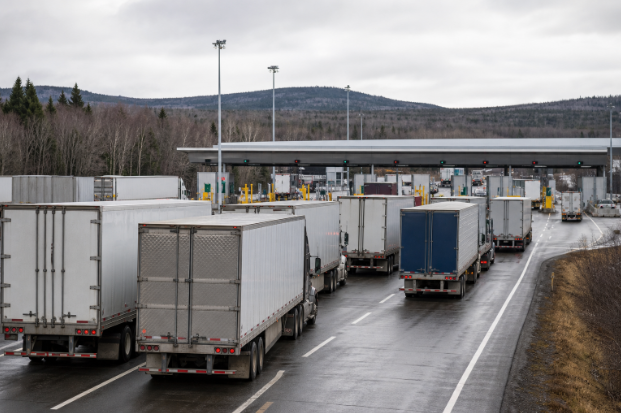
Fifty percent U.S. tariffs on almost $20 billion in Canadian goods took effect at midnight Friday, August 22, after trade talks that both governments had described as nearly complete collapsed in their final hours. Prime Minister Mark Carney, who days earlier had been optimistic enough to ask Canada’s provinces to put American liquor back on store shelves, told his negotiators to walk away from the table late Friday night, called the U.S. tariffs “a miscalculation,” and vowed Canada would “match those tariffs dollar for dollar.” Over the weekend, his government announced that Canada’s retaliatory tariffs take effect September 8. The collapse capped a week in which the tariffs were scheduled, paused with two hours to spare, rescheduled by White House proclamation, and finally triggered at midnight — a sequence that left businesses on both sides of the border pricing goods against a policy that changed direction four times in five days.
The Week of Whiplash
The 50 percent tariffs were originally set to take effect Tuesday, August 19. Less than two hours before the deadline, Trump announced a three-day pause, saying the two sides had reached a deal “subject to finalization of documents.” Carney confirmed the suspension. On Wednesday, August 20, a White House proclamation formally moved the effective date to 12:01 a.m. Eastern on Friday, August 22. On Thursday, high-level negotiators worked in Washington with less than 24 hours on the clock, and the public signals pointed toward resolution: Bloomberg reported the framework would cut U.S. tariffs on Canadian steel and aluminum to 25 percent and on Canadian autos to 15 percent, and Carney’s request that provincial liquor boards restock American alcohol — a reversal of one of Canada’s most visible retaliation measures — read as a government preparing to announce a deal. Then, late Friday night, Carney instructed his negotiators to walk away. The deadline passed, and the tariffs triggered automatically at midnight. Neither government has publicly detailed which final terms broke the negotiation.
What the Deal Would Have Done
The framework that nearly closed, as reported by Bloomberg and Canadian outlets, would have halved U.S. tariffs on Canadian steel and aluminum to 25 percent and cut auto tariffs to 15 percent — significant relief for the industries most exposed since the trade war began. Neither side released the full text or the complete terms, and the reported numbers were never confirmed officially by either government. What is documented is how close both sides believed they were: a presidential pause announced specifically because a deal was at hand, a prime minister unwinding retaliation measures in advance, and negotiators still at the table the day before the deadline. Whatever the sticking point was — and the reporting so far does not establish it — it was worth more to one side or both than the framework’s tariff relief.
What 50 Percent Hits
The tariffs that took effect Friday cover almost $20 billion in Canadian goods, per the Washington Post — a targeted tranche rather than all Canadian imports, though the two governments’ overlapping tariff layers from the past two years make the cumulative picture complicated. The economic exposure runs through the most integrated supply chains in the world. Canada is the largest buyer of American exports, and the auto industry moves parts across the Detroit-Windsor border multiple times before a vehicle is finished, which means a tariff at the border taxes the same car repeatedly. Steel, aluminum, lumber, and food cross in both directions. The People’s Podium has covered the consumer side of this all year: the grocery tariff tab, the Michigan manufacturing squeeze, and the price effects that arrive at retail within weeks of tariffs taking effect. Canada’s dollar-for-dollar response on September 8 will hit American exporters — farmers, distillers, manufacturers — in the same way.
The Missing Rulebook
The deeper reason every negotiation now ends at a midnight deadline is that the rulebook lapsed. The United States-Mexico-Canada Agreement, the trilateral trade pact that replaced NAFTA, came up for its scheduled review and was not renewed — a story The People’s Podium covered when it happened. Without a standing agreement, there is no default set of rules for the continent’s trade: every tariff is a unilateral action, every reduction is a one-off deal, and every deal is subject to collapse without a dispute mechanism to catch it. That structure — or its absence — is what produced this week: two governments improvising the terms of a trillion-dollar relationship against self-imposed deadlines, in public, with businesses reading presidential posts to learn what their costs will be on Friday.
Where Things Stand
As of Monday, the 50 percent tariffs are in effect, Canada’s retaliation is scheduled for September 8, and neither government has announced a return to the table — though this month has already shown how quickly that can change in either direction. The next two weeks are the window: if talks resume and close before September 8, the retaliation never lands and the framework may be revived; if not, the two countries enter the fall — and the American midterm season — in a full tariff exchange. Price effects from Friday’s tariffs will begin reaching American retailers within weeks, on the same calendar as the election. The People’s Podium will follow both clocks.