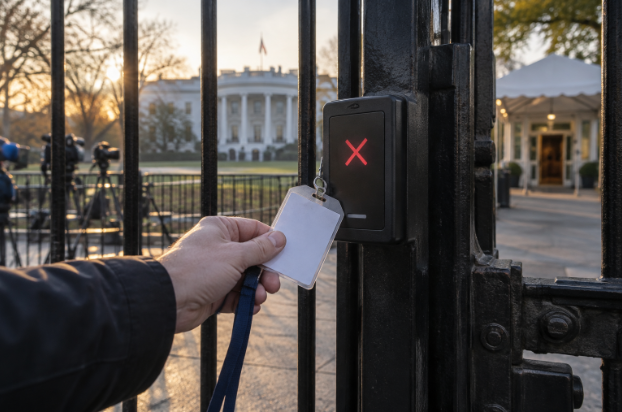
On Saturday morning, MS NOW correspondent Akayla Gardner passed through two security gates at the White House before her badge stopped working. An officer asked her to hand it over and told her the decision came from, in his words, above him. CNN’s Betsy Klein found her credential deactivated. Politico’s Cheyenne Haslett was stopped by the Secret Service, which confiscated her pass. By mid morning, three of the largest newsrooms covering the presidency had no way into the building they cover, 43 days before the election.
The order came Friday, on Truth Social. President Trump announced that CNN, MS NOW and Politico were banned from the White House for what he called “reporting FAKE NEWS,” and warned that “Other Fake News Media Outlets” could follow. Asked what specific story triggered it, he did not name one: it was “really just cumulative stories over the past few years.” He added, “They purposely write negative news,” called it a “very simple ban,” and said “the ban would go as far as you can.”
Hold on to one detail from the weekend, because it settles every argument about framing. The White House Correspondents’ Association pointed out that Trump described his own planned action as a “ban on the free press.” That is not our characterization or CNN’s. It is the author’s title for his own work. When someone tells you plainly what a thing is, believe them.
Understand what the banned reporters actually lost, because it is more than a seat at briefings. A White House credential is access to the grounds: the workspace where beat reporters write, Reporters’ Lane where correspondents do live shots, the ability to catch an official in a hallway and ask an unscripted question. Those three newsrooms staff some of the largest election coverage operations in the country, and they will now cover the presidency from outside the fence while voting is already underway in four states. The offense, again, was cumulative negativity, as judged by the person being covered.
Now the law, because there is one, and it is older than the president’s grievances. In 1977, in a case called Sherrill v. Knight, a federal appeals court held that once the White House establishes press facilities for credentialed journalists, it cannot deny access arbitrarily or for less than compelling reasons, and that a journalist losing a credential is owed notice of the factual basis, a chance to respond, and a final written explanation. What the three reporters got instead was a dead badge at a gate and an officer saying the decision came from above him. Jameel Jaffer of the Knight First Amendment Institute called the move doubly unconstitutional if it extends to the press pool, which courts treat as a public forum the government cannot curate by viewpoint. Seth Stern of the Freedom of the Press Foundation put it flatter: “It’s difficult to imagine a more blatant violation of the First Amendment than Trump banning news outlets from the People’s House for criticizing the government.”
There is also a live preview of how this ends up in court, because the administration has run this play before. In 2025 it stripped the Associated Press of access to the Oval Office and Air Force One for declining to adopt the name Gulf of America. The AP sued, and that case is still being litigated. The new ban is the same theory scaled up: access to the presidency as a reward for coverage the president likes. All three banned outlets say they will fight. CNN called the ban an “illegal assault” on constitutional rights. Politico said it will “vigorously defend” its First Amendment rights. MS NOW said it would take “any and all steps necessary,” and added the sentence that belongs on a courthouse wall: “The White House belongs to the American people and the decisions made inside are funded by our tax dollars.”
Put the weekend in the column where it belongs, because this is not a media industry story and we have been keeping the ledger all year. This administration subpoenaed reporters’ records at the New York Times. It defunded NPR and PBS and shut down the Corporation for Public Broadcasting until a court called it what it was. It rewrote the rules for who joins the press pool, restricted access to the press secretary’s office, and punished the AP over a name on a map. A Postal Service whistleblower we covered this month needed a lawyer to say in public what he saw at work. Each step tested whether anyone would stop it. The courts, so far, are the only ones who have.
If you do not watch CNN or read Politico, here is why this still lands on you. The precedent being tested is not about three outlets; it is whether the government you fund can decide which questions it takes and from whom, based on whether it likes the answers it got last time. That power, once established, transfers. It will belong to every future president of every party, sized to whatever they can get away with, which is exactly why a 49 year old court ruling says the White House does not get to pick its own press corps.
The First Amendment runs 45 words. The ban that tests it ran one social media post, named no specific story, and came with a promise of more. The reporters will sue, the courts will move, and in the meantime the fastest verdict available belongs to the people the White House says the building belongs to. Voting is open in four states. November 3. Forty three days.