
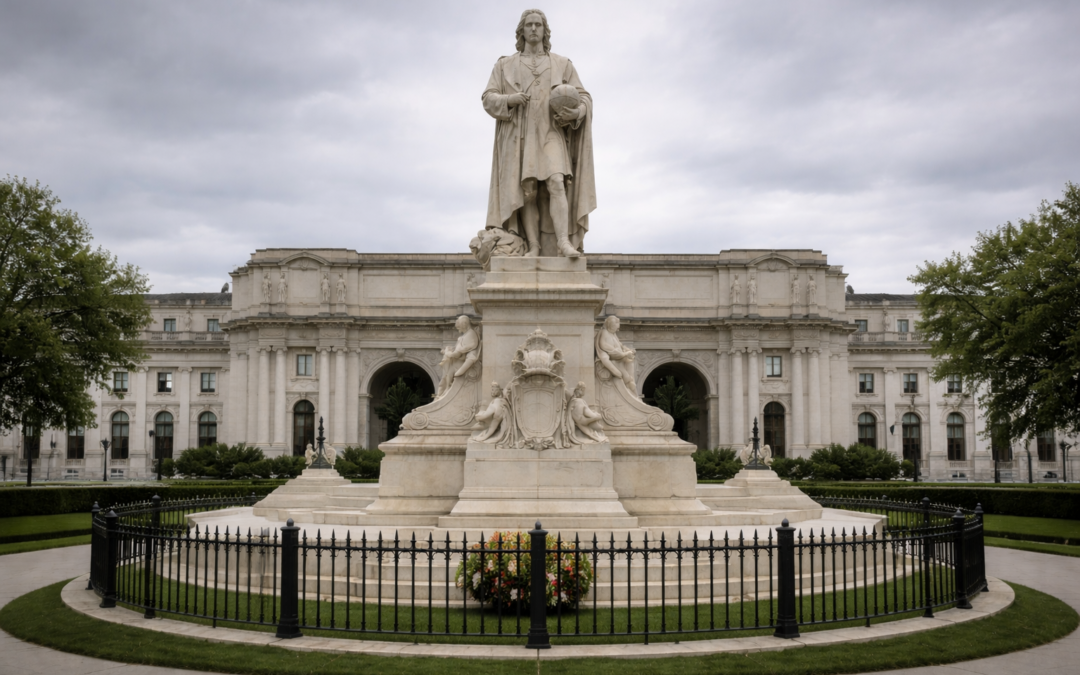
Something was missing from the White House grounds last week. By Monday morning, it wasn’t.
A 13-foot marble statue of Christopher Columbus — a replica of one that protesters wrenched from its pedestal and threw into Baltimore’s Inner Harbor in 2020 — now stands outside the Eisenhower Executive Office Building, steps from the West Wing. It went up over the weekend, quietly, behind rows of fencing that keep the public from getting close.
The Trump administration didn’t hold a ceremony. There was no public unveiling. The statue just appeared.
Who Put It There
The installation was a collaboration between the White House and the Conference of Presidents of Major Italian American Organizations, a group that pushed to rebuild the statue after the original was destroyed during the racial justice protests that swept the country following George Floyd’s murder.
The new statue was cast in part from pieces of the original retrieved from the harbor floor. Sculptor Will Hemsley created the replica, based on a work originally dedicated by President Ronald Reagan in 1984 — a detail the White House has emphasized to underscore its legitimacy.
Basil Russo, president of the organization, framed the installation as a matter of cultural pride. “Columbus statues have long stood as symbols of pride and cultural identity for more than 18 million Americans of Italian descent,” he said. “For over a century, Columbus’s legacy helped Italian immigrants navigate prejudice and hardship, serving as a source of unity and belonging as they built new lives in this country.”
President Trump, in a letter to the organization, praised the group for its “incredible generosity” and called Columbus “the original American hero, a giant of Western civilization, and one of the most gallant and visionary men to ever walk the face of the earth.” White House spokesman Davis Ingle added that the administration was “proud” to honor what he described as Columbus’s “legendary life and legacy.”
What the History Actually Shows
Christopher Columbus never set foot on the North American mainland. He made four voyages to the Caribbean and Central and South America between 1492 and 1504, and he died believing he had reached Asia. The land he encountered was already home to tens of millions of people.
His arrival marked the beginning of what historians broadly describe as centuries of colonization, forced labor, enslavement, and genocide across the hemisphere. Columbus himself oversaw brutal conditions in the territories he governed — conditions that drew condemnation even from some of his Spanish contemporaries.
Indigenous leaders and advocates have pushed back sharply on the installation, arguing that honoring Columbus on federal land erases the lived experiences and histories of Native peoples. In 2021, President Biden became the first U.S. president to formally recognize Indigenous Peoples Day — a recognition that dozens of states and cities have adopted in place of Columbus Day.
None of that history appears to have factored into the White House’s weekend decision.
Part of a Pattern
The Columbus statue is not a standalone gesture. It is part of a deliberate effort by the Trump administration to reverse the symbolic reckoning of 2020.
Across the country, in the months following Floyd’s murder, statues of Confederate officers, colonizers, and slaveholders were removed from public spaces — some by government action, others by protesters. The Trump administration has been methodically putting them back.
Earlier this year, a statue of Confederate officer Albert Pike was reinstalled in Washington, D.C. The administration has also announced plans to return a Confederate memorial to Arlington National Cemetery in Virginia, where it had stood for over a century before being removed in 2023.
The message being sent is not subtle. The figures being honored — Columbus, Pike, and others — were removed because communities decided their presence caused harm. The decision to bring them back is a decision about whose history gets told, whose discomfort matters, and who gets to define what America celebrates.
Behind the Fence
The Columbus statue currently stands blocked off by rows of fencing, across from the Smithsonian’s Renwick Gallery. It is not accessible for close public viewing.
It is, in other words, a symbol — one installed not for people to engage with up close, but simply to exist. To signal something about who this administration believes America’s heroes are, and who gets to decide.
The protesters who pulled the original into Baltimore’s harbor in 2020 were making a statement. The Trump administration, by placing a replica on federal grounds, is making one too.