
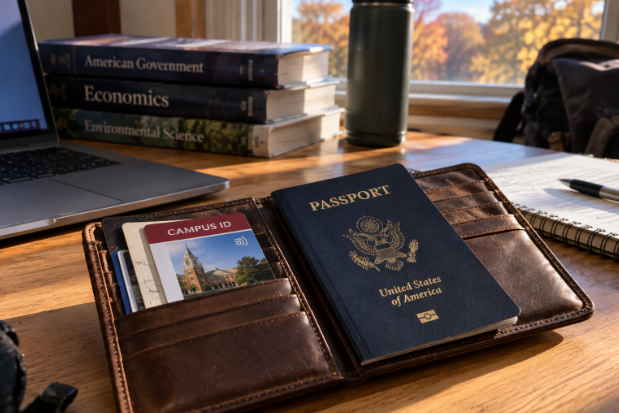
The order came down Thursday evening, unsigned and brief. The Supreme Court granted New Hampshire Republicans’ emergency request and cleared the way for the state to fully bar student IDs as voter identification in next month’s election, in the state carrying a Senate race that could help decide control of the chamber. One justice publicly dissented. The headlines say students cannot use their IDs to vote, which is true, but the order underneath is narrower and stranger than that, and the practical answer for an affected student is an errand, not a closed door. This piece walks what actually changed, why one judge and eight justices read the same law differently, and the fix that takes less time than the litigation did.
The arc matters because the Court did not rule on the law. New Hampshire’s law, signed by Governor Kelly Ayotte in April, removed student IDs from the list of identification election officials accept when a voter requests a ballot. A coalition of students and voting groups sued, and Judge Joseph Laplante, a George W. Bush appointee, let the law stand. What he blocked, in early October, was guidance from Secretary of State David Scanlan that went further than the statute, barring officials from considering student IDs even as backup evidence under a separate New Hampshire provision that lets voters establish identity through other documentation. Laplante ruled the guidance exceeded the law. An appeals panel left his order in place over one dissent. The Republican National Committee backed the state’s appeal, and Thursday the Supreme Court stayed Laplante’s order, which means the broader directive governs this election. Student IDs are out entirely, as primary identification and as backup evidence both.
The reasoning and the dissent each fit in a sentence, and both deserve printing. The majority leaned on the Purcell principle, the doctrine that federal courts should not change election rules close to an election, writing that the lower court did not point to anything justifying a deviation. Justice Ketanji Brown Jackson, alone in dissent, answered that even, and perhaps especially, when an election is looming, she would not disturb a clearly justifiable order issued to ensure the public receives accurate information about a state’s electoral processes. Strip the doctrine away and the disagreement is about who caused the confusion, a judge changing rules late, or officials overstating a law. The Court chose the first reading. Either way, the operative fact for a voter is settled and identical. The ID in a student’s wallet does not work at the ballot table this year.
Who this touches is a matter of public arithmetic. New Hampshire’s campuses, Dartmouth, the state university system, and the rest, enroll tens of thousands of students, many from out of state, in a state where statewide elections have been decided by four digit margins within recent memory. This year’s ballot carries the Senate race between Chris Pappas and John E. Sununu, a contest sitting near the center of the fight for the chamber, the same race where the Republicans’ own 2022 nominee crossed over to endorse the Democrat, a defection this newsletter logged last week. None of that makes the ruling wrong or right. It makes the stakes of paperwork concrete.
So here is the paperwork, which is the part worth forwarding to anyone on a New Hampshire campus. The state’s accepted list still includes a driver’s license from New Hampshire or any other state, a New Hampshire nondriver identification card, a United States passport, and military identification. A student with a home state license or a passport in a drawer already has what they need. A student with neither can get a nondriver ID at a New Hampshire DMV office, an errand that fits inside the eleven days remaining, documents and a modest fee required. And for voters who arrive with none of it, the separate provision allowing officials to weigh other evidence of identity still exists, now minus student IDs, which makes it a last resort rather than a plan.
One distinction saves votes, so it gets its own paragraph. Registering to vote and proving identity at the ballot are different steps under New Hampshire law. The ruling changed the second, not the first. A student domiciled in New Hampshire remains an eligible voter, and the state’s courts struck down attempts to entangle voting with residency obligations like license transfers years ago. Same day registration exists on Election Day with its own domicile documentation. What Thursday changed is the card shown at the table, not who is allowed to stand at it, and conflating those two is how eligible people talk themselves out of voting.
The channel this arrived through belongs to a pattern this page has tracked all month. The emergency docket, unsigned and unargued, has now shaped the mail ballot rules, the federal database fight, and the ID list in a Senate battleground, all inside the final weeks. Add Thursday’s order to the week’s courtroom ledger, a state sued over its rolls, a county suing over armed agents, the opposition leadership suing over threats, and a one paragraph order rewriting a poll table rule eleven days out. Whatever one thinks of any single ruling, the volume of election mechanics being decided this close to the counting is itself a fact about this election.
The honest accounting runs both ways. States set identification rules, uniform standards are a legitimate aim, and New Hampshire’s attorney general framed the order as protecting election integrity and laws as written, preventing last minute court orders from creating uncertainty. The challengers call the law a solution in search of a problem, and the coverage records no evidence of student ID fraud driving it. The genuinely close legal question, whether guidance exceeded a statute, is the kind a Bush appointed judge and a near unanimous Court can honestly split on. What both sides claim to want, clear rules, now exists by order. The rules are clear. They are also stricter, and the clarity arrived with eleven days to adjust.
Which returns the piece to its title. For a New Hampshire student the ruling is an errand, a passport dug out, a home license used, a DMV visit made, then a ballot cast early or on the day. The state’s own political lore says a few thousand such errands have decided senators before. The appeal continues after the election, the order is final for this one, and the standing rule of this season holds. The briefs argue. The ballots count.