
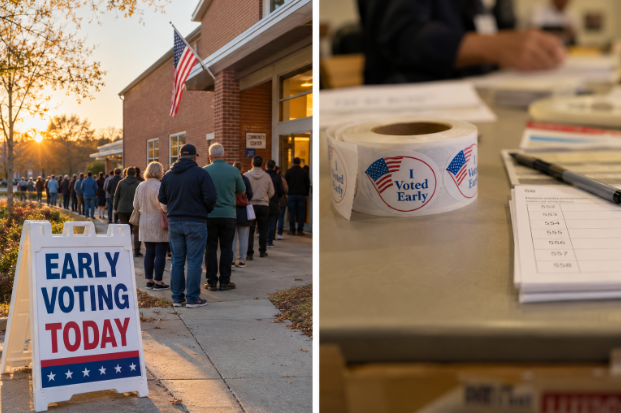
Early voting opened Monday in seven more states, and the records started falling before the first day ended. Harris County, Texas, home to Houston and nearly five million people, counted 104,660 in person voters, shattering its previous midterm first day record of 63,188 from 2018 by two thirds, with another 24,794 mail ballots received the same day. A week earlier, Georgia opened its window and 188,667 people voted in person on day one, 40 percent above the 2022 midterm mark and nearly triple 2018. Those are not close calls with old records. They are different weather. This piece lays out the numbers, what they reliably mean, what they cannot tell you no matter who claims otherwise, and the one thing worth doing with them, which is checking your own state’s calendar.
The map first. North Carolina and Georgia have been voting for a week. Monday added Texas, Florida, Colorado, Connecticut, Alaska, Arkansas and South Carolina to the in person list, and the eight all mail states have had ballots in circulation since early October. By this weekend, a majority of states will be actively voting, and the campaigns know it, the president is rallying in North Carolina, South Carolina, Iowa, Florida and Georgia this week with Texas next, which is a travel schedule built around where ballots are already moving.
The numbers deserve their own paragraph because of where they come from. The Georgia figures are the secretary of state’s own, published on his office’s data hub, and Brad Raffensperger, a Republican, framed the record as proof voters have confidence in the integrity of the state’s elections. Georgia’s May primary showed the same pattern, over a million early votes against a previous record of 857,000. In Texas, the clerk’s numbers came with smooth operations across more than 70 sites, and the surge was not just Houston, Dallas, Collin and Denton counties reported record or near record midterm openings the same day. Both parties showed up to claim it in person, the governor toured Houston polling areas on day one after investing 25 million dollars in Harris County turnout, and Democratic surrogates filmed at the same polls hours apart.
Now the honest part, what early vote totals reliably mean. They are a measure of enthusiasm and logistics, not outcomes. Decades of research and several recent cycles say the same thing, big early numbers mostly tell you when people vote, not how the final margin lands, because a large share of early voters are reliable voters who simply moved their ballot forward. A record first day is real information about engagement and about strain on the system. It is not a forecast, and anyone reading a winner off it is guessing with confidence.
This cycle adds a wrinkle that makes composition reading even less reliable than usual. The president spent October telling his own voters to vote early and by mail, reversing years of his own rhetoric, a shift this newsletter covered when it happened. If Republican early numbers rise, that may be method shift rather than new voters. If the Democratic share of the early vote shrinks from past cycles, Democratic margins can still grow on Election Day math. Both parties will spend the next two weeks quoting the same running totals as proof of opposite things, and both will be reading tea leaves. The level of turnout is knowable. The meaning of its composition is not, until the counting.
What records do change is the mechanics, and this is where they genuinely matter. Every ballot banked early is one less Election Day failure point, a shorter line, a lighter load on poll workers, and crucially, time. An early voter whose mail ballot has a signature problem gets contacted and cures it. A voter who finds a registration issue on October 20 can fix it. The same problems discovered on November 3 become provisional ballots and lawsuits. Election officials in both red and blue states have spent the week making this exact point, and in a season when ballot counting itself is in federal court in California, a story this page covered yesterday, tens of millions of ballots moving through the system without incident is the machinery working in public view.
Texas earns its close up. The state Democrats have not won statewide since 1994, 32 years, and their Senate nominee just posted the largest fundraising quarter in Senate history, which is why a record midterm opening in the state’s biggest county reads like a thunderclap to one side and a turnout war to the other. The honest read is narrower. Harris County’s first day nearly matched its own 2020 presidential opening, in a midterm, with both parties’ machinery fully engaged and the governor’s 25 million dollars working the same precincts. Something unusual is happening in Texas turnout. Which direction it cuts is exactly what the early numbers cannot say.
So here is the service close, three moves while the records pile up. First, find your state’s window, it is probably open or opening this week, and the close dates vary, Georgia and Texas both end early voting October 30. Second, if you hold a mail ballot, return it this week, by mail now or a drop box later, and track it online the way the mail guide laid out. Third, if anything about your registration looks wrong, today is the day you can still fix it. The records are a collective fact. Whether your ballot is inside them is the only part you control.
The totals will climb every day for two weeks, the spin will climb with them, and both will be quoted at you hourly. Keep the two ledgers separate. The count of ballots banked is real, public and growing. The meaning everyone assigns it is a guess wearing a confident voice. The number that ends the argument gets counted after November 3, and the surest way to be in it is to vote while the lines are short and the fix it window is open.