
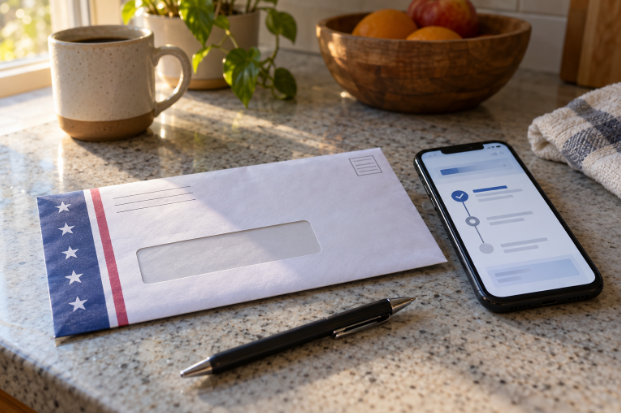
The permission arrived in two parts. Saturday, in a video posted to his social media account, President Trump told Republicans to use every tool available, vote early, vote absentee, vote by mail, or vote in person on November 3. Monday, on the South Lawn, he said it plainer. He would rather people vote in person, but they can vote by mail if they want, because, in his words, we seem to have no choice. He repeated, in the same breath and without evidence, that mail voting is full of cheating. Readers can hold the contradiction. The useful response to a permission slip is not an argument about the signer. It is instructions. So here is how mail voting actually works for this election, deadline by deadline.
One paragraph of context, because the turn is real. This is the same president who called the method corrupt and a disaster, who blamed it for 2020, and whose stated goal as recently as last year was ending it outright. He has also voted by mail himself twice this year in Florida. The practical math behind the reversal is not mysterious. His party’s voters bank far fewer ballots before Election Day than the other side, a gap his own rhetoric helped dig, and strategists have warned for years that rural voters far from a polling place were the ones being talked out of their easiest option. Even Republican senators noticed the shift, one of them circulating the headline about the critic of mail voting now urging it. Whatever the motive, the method just lost its loudest opponent.
Step one is knowing which of three systems your state runs. Eight states and Washington, D.C. mail a ballot to every active registered voter automatically, California, Colorado, Hawaii, Nevada, Oregon, Utah, Vermont and Washington. There is nothing to request. Watch the mailbox, ballots are going out now. Most of the remaining states let any registered voter request a mail ballot for any reason, no excuse needed. And nine states still require a stated excuse, Alabama, Indiana, Louisiana, Mississippi, Missouri, New Hampshire, South Carolina, Texas and West Virginia, though the approved reasons are broader than people assume. In Texas, for example, being 65 or older is itself a qualifying reason.
Deadline one is the request, and the calendar is tighter than it looks. Request deadlines in most request states cluster in late October, with some landing earlier, North Carolina requires the county board to have your form a full week before the election, and Florida makes you request fresh each election cycle even if you had mail ballots before. The legal deadline is a trap in its own right, because it assumes the mail moves faster than it does. The working rule from election officials is simple. If your state needs a request, send it this week, not deadline week.
Deadline two is the return, and this is where most mail ballots die. Roughly 35 states use a received by rule, meaning your ballot must be physically in election officials’ hands by the time polls close on November 3, and that list includes Florida, Georgia, Iowa, Michigan, Ohio, Pennsylvania and Wisconsin. About a dozen states plus D.C. use a postmark rule instead, counting ballots postmarked by Election Day that arrive within a grace window, three days in Kansas, Massachusetts and Virginia, four in Nevada, seven in California and Colorado, out to certification in Washington state. Louisiana wants mailed ballots received the day before the election. The rule of thumb that covers every state is the one Oregon, the oldest mail voting state, gives its own voters. Mail it a week out. Inside a week, use a drop box or hand it to your election office.
Now the detail that catches people, the postmark trap. Since late December, the Postal Service has not postmarked mail where you drop it off. The stamp gets applied when the envelope reaches a regional processing facility, which can take a day or more. In postmark states, that stamp is your proof you voted on time, which means a ballot dropped in a blue box on Election Day can carry the next day’s postmark and die for it. If you are mailing late in a postmark state, take the envelope to the post office counter and ask for a hand stamped postmark with that day’s date. The courts, for their part, have left the rules standing. Twice this year the Supreme Court declined to rewrite mail voting before November, including a five to four opinion holding that states may count late arriving ballots postmarked on time, even as the administration pressed yet another emergency appeal over Postal Service ballot rules in the same season the president blessed the method. You do not have to wait on that docket. A ballot returned early is outside the argument entirely.
Then protect the ballot you send. Sign the envelope the way your signature appears on your registration, because a mismatch is a leading cause of rejection, and most states are required to contact you and give you a chance to fix it, a process called curing. Answer that call or letter, it is real. Nearly every state now lets you track your ballot online the way you track a package, mailed, received, counted, so check the status a few days after you send it. And if you request a mail ballot and then decide to vote in person, the rules change, in most places you should bring the mail ballot with you to surrender, or expect to cast a provisional ballot while officials confirm you did not vote twice.
The whole piece reduces to five moves. Know your system, automatic, request, or excuse. If a request is needed, send it this week. Return the ballot a week early by mail, or use a drop box inside a week. In a postmark state mailing late, get the hand stamp at the counter. Then track it and answer any cure contact. Total time, maybe twenty minutes, most of it finding your county election website, and every minute of it is within your control, which is more than can be said for most of what this newsletter covers.
Tens of millions of mail ballots will move through the system this month, the method’s loudest critic just told his own voters to use it, and the machinery for making sure yours counts is public, trackable and free. The argument about mail voting will keep running on television. Your ballot does not have to be part of it. The permission slip is new. The mailbox was always open.