
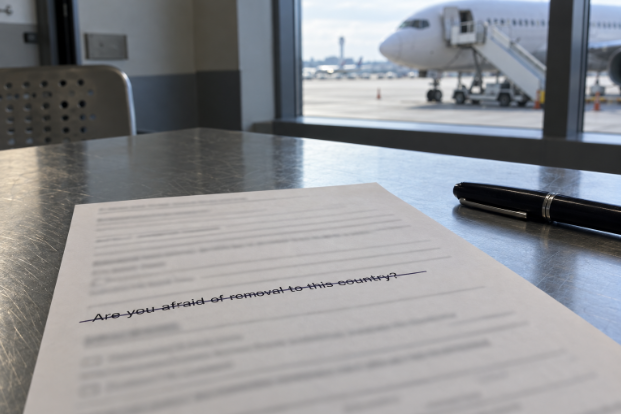
The instruction is written into the government’s own deportation policy, and a federal appeals court quoted it in full last week. Before removing someone to a country not named in their removal order, DHS’s guidance says, “Immigration officers will not affirmatively ask whether the alien is afraid of being removed to that country.” That was the generous track. On the other track, where the State Department believed a receiving country had promised not to persecute or torture deportees, the policy required no notice at all: the person could be “removed without the need for further procedures.” On September 18, the court struck the policy down. On Thursday, the Trump administration asked the Supreme Court to bring it back.
Start with what the 1st U.S. Circuit Court of Appeals actually held, because the ruling is narrower than either side’s rhetoric. In D.V.D. v. Department of Homeland Security, a unanimous three judge panel upheld the core of Judge Brian Murphy’s February judgment: federal law requires DHS to give people “effective notice” that it intends to remove them to a specific third country, and a “meaningful opportunity” to argue they would be persecuted or tortured there, before the plane leaves. The panel put the logic in one sentence: the right to contest removal to a dangerous country “means little if one does not receive prior notice of the intended removal destination and a meaningful opportunity to contest that destination.” The court did not ban third country removals. It even handed the government a partial win, throwing out on standing grounds the requirement that DHS first try to send people to their home countries. What survived is notice and a hearing. That is the entire ruling now under emergency appeal.
The policy the court reviewed rested on “diplomatic assurances,” promises from receiving countries that deportees would not be harmed. The judges were openly skeptical, writing that they had “some difficulty seeing how a receiving country can credibly provide blanket assurances” covering every person sent there. And the court’s opinion cites a data point on what those assurances have been worth. According to a Senate Foreign Relations Committee minority report quoted in the ruling, as of January 2026 “more than eighty percent of the migrants sent to third countries paid by the United States to take them in have already returned to their country of origin or are in the process of doing so.” The opinion gives a name to that round trip: one of the original plaintiffs, O.C.G., had won protection from removal to Guatemala because he would likely be persecuted there. The United States sent him to Mexico instead. Mexico deported him to Guatemala.
Now the week between the ruling and the appeal, because it is its own story. The night the decision came down, DHS general counsel James Percival posted that the policy “continues, as the First Circuit’s ruling is not currently in effect,” and Justice Department lawyers took the position that the decision would not bind the government until the court completed a procedural step called issuing the mandate. The removals kept moving. According to a DOJ filing first reported by The American Prospect, ICE asked a judge on September 22 to let it transfer a Peruvian man out of Massachusetts “to effectuate his removal to the Central African Republic on Sept. 24.” The man, identified in court papers as John Doe, had won protection under the Convention Against Torture in May 2025 after showing he would likely be tortured in Peru. The class’s lawyers filed an emergency motion at 8:20 Wednesday night. At 11:36 p.m., the panel answered in a single sentence: “Consistent with this court’s September 18, 2026, Judgment, the March 16, 2026, stay pending appeal is dissolved.” The flight did not happen.
By Thursday afternoon the administration was at the Supreme Court. Solicitor General D. John Sauer’s application says the ruling has “created substantial logistical problems with ongoing removal operations,” including canceled flights, added expense, diplomatic complications and “the inability to remove dangerous criminals.” The government says it has pulled nearly 150 people from removal flights to at least four countries, including one canceled flight carrying 70 people with criminal convictions bound for three nations. And Sauer told the justices the stakes going forward: the government has removed thousands of people to third countries in recent months, and “thousands more are eligible for such removal.” The Court ordered the class to respond by Monday afternoon.
The scale is not in dispute, because DHS announced it. Percival wrote on X that 25,000 people have been deported to third countries, posting the figure alongside a clip of Taylor Swift admiring her wedding ring and a joke that this is how his wife looks at him when he shares the number. The Associated Press reports that the vast majority went to Mexico, with thousands of others sent under a series of often secret agreements to more than two dozen countries, from Liberia to Guyana. Some of what awaits them is on the record. Lawyers for two men deported to Equatorial Guinea said this month their clients were beaten and held at gunpoint in a hotel turned detention center, with bags over their heads. Last year, a group bound for South Sudan spent weeks held at a U.S. military base in Djibouti while courts fought over their removal.
Take the government’s argument seriously, because parts of it are true. Some countries refuse to take back their own citizens, and the administration says third country agreements are how it removes people, including people with serious criminal records, who would otherwise be unremovable. Hearings take time, and the filing warns of cascading delays and reworked diplomatic deals. But hold that against what the court actually ordered. Not release, not a ban, not a restart of anyone’s case. Notice of the destination, and a chance to say the destination is dangerous, under statutes Congress wrote to keep the United States from delivering people to persecution and torture. The court noted the Supreme Court’s own recent holding that roughly 24 hours’ notice, with no explanation of how to object, does not satisfy due process. The policy under review offered that much only sometimes, and sometimes nothing.
The justices know this case. In June 2025 they stayed Murphy’s earlier injunction and let the flights continue while the appeal ran, over the dissent of Justices Sotomayor, Kagan and Jackson, and they later sided with the administration again over the group held in Djibouti. Both of those were emergency orders about an unfinished case. This time is different in kind: the 1st Circuit has now affirmed a final judgment on the merits, after full briefing and argument. Whether that changes any votes is the question the next few days will answer, and with a response due Monday, the answer could come fast.
Put the week in the ledger where it belongs. A public detainee locator switched off for the people closest to removal. A citizen in an ambulance while the official statement said without further incident. And now a government that read a court loss as optional until a panel had to repeat itself at midnight, then asked the Supreme Court to make the loss disappear. The instruments differ. The instinct is the same: move faster than anyone can object. The courts have been the brake so far. The other one is already open in four states. November 3. Thirty seven days.