
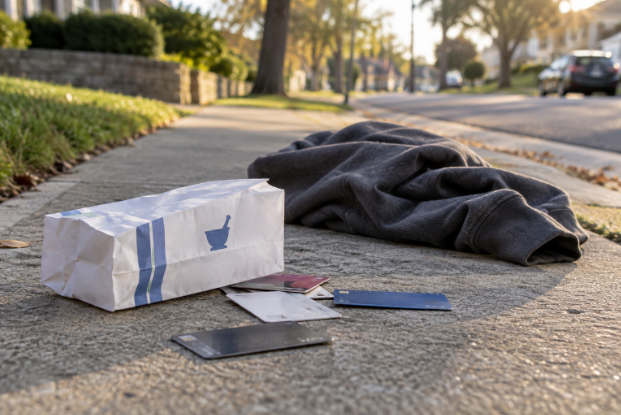
On a Sunday morning in Evanston, Illinois, a man walked to the pharmacy to pick up a prescription. Five federal vehicles were in the neighborhood hunting a fugitive with a Chicago address, and the agents decided this man, a Black U.S. citizen out on foot just before 10 a.m., resembled their target. What happened next put him in an ambulance with injuries to his head, neck and teeth, left his wallet’s contents scattered on the road, and produced two accounts of the same morning so different that only one of them can be describing what the witnesses filmed.
Start with what local police say. According to the Evanston Police Department’s own release, a federal agent told responding officers that five agents in separate vehicles were seeking a fugitive with an arrest warrant, that they mistook this man for him, that they tried to handcuff him when he refused to provide identification, and that they released him once they realized he was a citizen. One Evanston officer saw blood on the agent’s hands. The agents, by their own telling, left immediately afterward because they feared the crowd that had gathered. Evanston police have since visited the man in the hospital, photographed his injuries, and opened an investigation.
Now the witnesses, on the record with the Associated Press. Ryan Garton, 56, was driving home when he saw agents pinning the man to the roadside, and pulled over to film. One agent had a knee on the man’s back and was, in Garton’s words, “beating up on him.” The man screamed “I’m a citizen, leave me alone” while roughly five bystanders yelled at the agent to stop. Garton says that when he urged the agent to get off so he could check the man’s injuries, the agent acknowledged already knowing the man was a U.S. citizen. When the agent stepped away, Garton saw bloodstains in the shape of handprints on the man’s shirt, a right eye socket and temple swollen “as if he had been punched,” and a face scraped “as if it had been ground into the sidewalk.” Michael Lipson, who owns the store across the street, watched agents wrestle down a man repeatedly yelling that he was a citizen, then check the cards in his wallet and leave the papers scattered on the pavement. Lipson laid his own sweatshirt on the ground so the man could rest while Garton looked him over.
Here is the Department of Homeland Security’s official account of that same morning, quoted in full so you can hold it against the ambulance. Officers “encountered an individual who resembled the target” of a “targeted enforcement operation.” The individual “was given lawful commands but was not cooperative and refused to identify himself.” The officers “left the scene without further incident.” And: “When ICE officers offered the individual assistance, he refused.” Without further incident is a remarkable phrase to attach to a morning that ended with hospital photographs of a citizen’s face. The government’s version and the witnesses’ version cannot both be true, and only one side left before the cameras could settle it.
Sit with the premise buried in that statement, because it is the whole story. The government’s defense is that a citizen, walking to a pharmacy in his own town, was obligated to produce identification for armed strangers on demand, and that what followed is on him for declining. That is not how this country works. There is no walking around papers requirement for Americans on an ordinary sidewalk, and the man face down on the pavement was asserting exactly that distinction, out loud, the entire time. “I’m a citizen, leave me alone” is not resistance. It is the actual rule.
Evanston is not an isolated morning. The same Sunday, an ICE agent shot and wounded a man in Austin, Texas. ICE announced a record for August: nearly 51,000 arrests in a single month. At least 10 people have died in encounters with immigration agents during this administration, including a Colombian man shot dead in Maine in July by an agent with a documented history of violence, a Mexican man struck by a tractor trailer while fleeing agents in Florida, and two U.S. citizens, Renee Good and Alex Pretti, fatally shot during the Minneapolis operation the administration named Metro Surge. Run arrests at record volume with five car teams working from resemblance, and the error rate stops being a statistic. It becomes a man who wanted his prescription.
The local response tells you where the checks now live. Evanston’s mayor, Daniel Biss, confirmed the man was treated at St. Francis Hospital and said the city “continues to investigate the situation, and we will remain vigilant about federal activities.” Representative Jan Schakowsky: “I am disgusted and outraged by reports of what happened in my hometown of Evanston on Sunday.” Note the inversion: a municipal police department is investigating federal agents, photographing the injuries federal statements do not mention, building the record the official account left out.
That is also why this story connects to the one we told Wednesday. This same month, ICE switched off its public locator for thousands of detainees, and a court had to order transparency facility by facility. In Evanston, the gap between “without further incident” and the truth exists on the record only because a driver pulled over to film, a store owner gave up his sweatshirt, five strangers yelled stop, and a local police department took photographs. The official account is a choice. So is the witnessed one. Keep being the witnesses, and keep the date that decides which kind of record this country keeps. November 3.