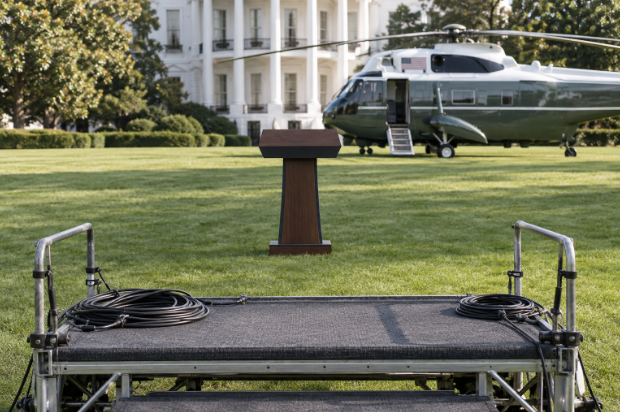
On Monday afternoon, President Trump cut the ribbon on his new White House helipad, and almost nobody heard a word of it. There was no audio feed, because there were no pool cameras, because the network assigned to film the president had been banned from the grounds and the other networks refused to take its place. A Newsmax correspondent explained the silence to conservative viewers live on air: “There is no microphone because the pool cameras aren’t there,” adding, “Can’t hear what the president’s saying.” Three days into the ban on the free press, the first person it silenced was the president.
Here is how the microphone died. For decades, the networks have shared pool duty: one crew films the president’s events and feeds the video to everyone, a system both parties’ White Houses have relied on. CNN was Monday’s assigned pooler. After CNN’s reporter was turned away Saturday, the White House put out guidance at 10:55 Sunday night quietly dropping CNN from the rotation. Then the other four members of the TV pool, NBC, ABC, CBS and Fox News, declined to step in. All five networks, Fox included, signed one statement: “The public has a vital interest in receiving accurate, independent information about its government. No administration should restrict a news organization because it objects to its reporting.” When Fox News is on the same page as CNN, the page is worth reading.
The second front opened Monday morning in federal court. CNN, Politico and MS NOW filed a 27 page lawsuit in the District of Columbia, and they did not file it alone: the three reporters whose badges died at the gates, Betsy Klein, Cheyenne Haslett and Akayla Gardner, are plaintiffs by name. The defendants are the president, communications director Steven Cheung, Secret Service director Sean Curran, and chief of staff Susie Wiles. The claims are the two we walked through yesterday: the First Amendment, and the due process the 1977 Sherrill ruling requires before a credential can be pulled. The complaint’s first move is to quote the president’s own posts: he “was expressly clear about his viewpoint discriminatory motive.” As Stanford law professor Evelyn Douek put it, Trump’s explanations “make the First Amendment arguments much easier to establish.” His words are their Exhibit A.
Now the detail that makes this case feel like a rerun with higher stakes. It landed before U.S. District Judge Timothy Kelly, a Trump appointee from 2017, and Kelly has seen this exact play before. In 2018, when the White House stripped CNN correspondent Jim Acosta’s hard pass after a contentious press conference, Kelly ordered the pass temporarily restored. Days later the administration gave it back permanently rather than keep fighting. Same judge, same building, same theory of the case, except this time it is three newsrooms instead of one reporter, and the president has already begun attacking the judge he appointed. Kelly gave the administration until today to respond and set a hearing for Wednesday afternoon on the restraining order that would switch the badges back on.
Inside the building, this does not read like a plan. Four officials told NBC News that senior aides were caught off guard by Friday’s announcement. Wiles, the chief of staff now named as a defendant, was reportedly not even at the White House when it went out. Trump had floated banning specific outlets earlier in his term and been talked out of it. And the enforcement is arbitrary in ways the lawsuit will enjoy: an MS NOW photographer was turned away Saturday while an MS NOW producer was waved through, and no one has explained the difference. A ban whose own gatekeepers cannot say who is banned is not a policy. It is a mood with a badge reader.
The defenses offered so far keep restating the offense. Vice President Vance said Trump was “not banning media outlets,” a claim contradicted by the president’s own post announcing he was “banning” them. Standing next to New York’s mayor on Monday, Trump said that “if they’re fake news, I really think I have an obligation not to allow them into another very special house.” By Monday morning he was posting that the news media is “a threat to our National Security, and must be stopped, NOW!” Treasury Secretary Scott Bessent offered that the media “equilibrium is so far out of kilter.” Senator John Barrasso said the press “has an obligation to report fairly.” Every one of those statements describes punishing coverage for its content, which is the thing the First Amendment exists to forbid, which is why the complaint quotes them.
The people who study this law think the outcome is not close. USC media law professor Jonathan Kotler: “If I was in Vegas now and I had to bet on this, I would think that the press is going to win at every level up until the Supreme Court,” with the honest coda, “You just never know with the Supreme Court.” The Knight Institute’s Jameel Jaffer reframed the stakes: this is presented as retaliation against three outlets, but “it’s really a move against the public’s right to know.” The AP’s Gulf of America case, the same theory in miniature, is still grinding through the courts a year and a half later. The difference here is speed: a restraining order can move in days. The Acosta case took less than a week, start to surrender.
So watch tomorrow afternoon. The administration’s response is due today. Judge Kelly hears the restraining order request Wednesday. If he follows his own 2018 precedent, three newsrooms could have their passes back before the week is out, and the ban on the free press will have accomplished a silenced helipad ceremony, a five network revolt, a federal lawsuit naming the chief of staff, and nothing else. Voting is open in four states, with more opening every week. November 3. Forty two days.