
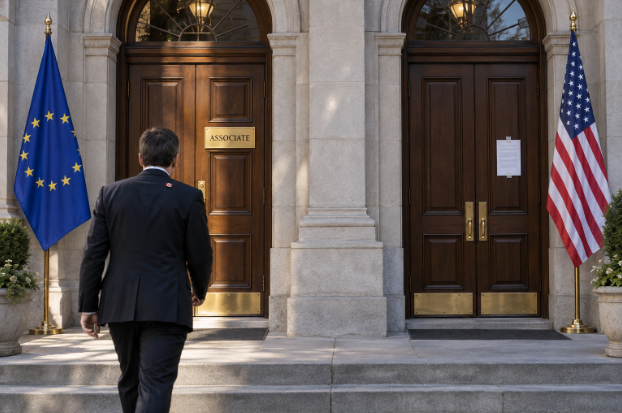
On Wednesday, in her State of the Union address, European Commission President Ursula von der Leyen proposed something that has never existed: associate membership in the European Union, and she named the country she wants to hold it first. Canada. By Thursday, President Trump had called the idea potentially a “hostile act” and threatened, in his words, “very heavy tariffs on Europe” if he judged its intentions bad. Between those two statements sits the story of what eight months of tariffs actually bought.
Start with the offer. The European Union has members and it has trade partners, and nothing in between. Von der Leyen proposed building the in between and starting with Ottawa: moving beyond CETA, the existing EU Canada trade agreement, to what she called “an alliance for the future,” a “common prosperity and economic security space” spanning manufacturing, artificial intelligence, critical minerals and energy. The details do not exist yet. The category does not exist yet. That is the point: the EU is inventing a new tier of belonging, and the first invitation went to a country whose southern border used to make one unnecessary.
Prime Minister Mark Carney did not stumble into this. Earlier in the week he said Canada was seeking a “unique alliance” with Europe, not membership. When the offer came anyway, his office welcomed it as a way “to strengthen our sovereignty,” and on Thursday Carney stood in front of the European Parliament and said Canada and Europe are not “fair weather allies.” Asked about Trump’s mockery, he said the proposal was not “laughable.” The prime minister of Canada spent his week in Brussels being applauded for hedging against the United States. Sit with how new that is.
Now the ledger of how we got here, because none of it is mysterious. The administration put 50 percent tariffs on a growing list of Canadian goods, the latest tranche covering 110 products just last week. Talks collapsed twice this summer. The president has repeatedly floated making Canada the 51st state, a line Carney has answered with one word, never. And Canada’s retaliatory import ban takes effect September 29, nine days from today. Every one of those pressures was supposed to make Ottawa fold toward Washington. The measurable result is Ottawa negotiating a new category of partnership with Brussels.
Thursday’s response completed the circle. Trump called Canada a “terrible trade partner,” called the arrangement “laughable,” and threatened heavy tariffs on Europe over it. Read that sequence plainly: the answer to allies routing around American tariffs is a threat of more tariffs, on more allies. It is the trade policy equivalent of the purge database argument we covered last week, where the fix for a failed system was to run it harder.
What does any of this mean for your grocery bill? Two things, one now and one structural. Now: the tariffs you have been paying since summer do not move an inch because of anything said in Brussels. Vermont’s cheesemakers still face an 80 percent collapse in cross border sales; Michigan and Indiana supply chains still carry the surcharge; the counter tariffs still land on the shelf price. Structural: if Europe and Canada build a preferential space while our tariff walls stand, American exporters lose ground in both markets at once, not for a quarter but for a generation. Trade architecture, once built, does not care who wins our next election. It just stands there, collecting.
Be honest about what is real and what is theater. Associate membership has no legal definition yet, and EU treaty mechanics move in years, not weeks. Skeptics in Brussels will fight it; some member states guard the club’s edges jealously. But the pieces that matter can move fast without treaty change: procurement, defense industry access, critical minerals agreements, energy coordination. And the symbolism is already fully operational. Eight weeks before an American election, our closest neighbor is shopping for a second home, and the continent that spent 80 years anchored to Washington is holding the door.
The calendar from here: Canada’s import ban lands September 29. The EU begins turning a speech into a legal proposal over the coming months. And the only people who can change the direction of the American side of this are the ones already lining up at early voting sites in four states. November 3. Forty four days.