
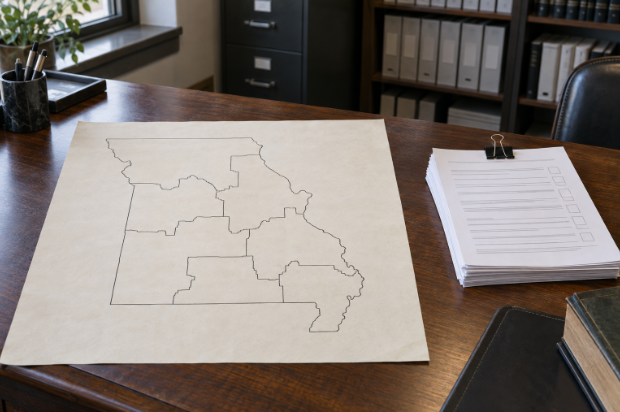
The Missouri map war ended Thursday, in the right order and just barely. In the morning, the U.S. Supreme Court stayed the federal court order that had briefly revived the state’s Trump-backed congressional gerrymander, effectively throwing the map out for November. Minutes later, Secretary of State Denny Hoskins walked into the Missouri Supreme Court for a contempt hearing where his own lawyer would not promise the fight was over, telling the justices Hoskins was “evaluating next steps.” The chief justice advised Hoskins not to travel far from Jefferson City. By afternoon, the court had ruled: Hoskins was in contempt when he ordered local clerks to use the invalidated map. Hours later he folded, directing every election authority in the state to use the 2022 map, which the court then accepted as purging his contempt. The bottom line for voters: Kansas City’s congressional district survives, Missouri’s November races run on the 2022 lines, and the referendum on the gerrymander stays on the ballot, where the people who forced this whole reckoning, more than 300,000 petition signers, get the last word after all.
The Supreme Court Ends It
Thursday morning’s order resolved the two-map standoff this newsletter described yesterday. On Tuesday, Justice Brett Kavanaugh had refused to revive the gerrymander at the state’s request; twenty-eight minutes later, Chief U.S. District Judge Stephen Clark ordered Missouri to use it anyway, in a suit brought by Republican candidates. Thursday, the Supreme Court stayed Clark’s order, per St. Louis Public Radio, removing the only legal foundation the map had left. With the federal order paused, the Missouri Supreme Court’s unanimous September 3 ruling stands alone: House Bill 1 “is not the law and has never been the law,” because more than 300,000 voters petitioned it onto the ballot for a veto referendum, and under Missouri’s constitution that suspends the law until the voters speak. Even Hoskins’ Thursday statement conceded the architecture: “Following the United States Supreme Court’s stay, the only governing court order in effect is from the Missouri Supreme Court. In accordance with that order, my Office is directing local election authorities to use the 2022 congressional map.”
The Hearing
The contempt hearing that began moments after the Supreme Court’s order was, by the accounts of reporters present, remarkable. Missouri’s principal deputy solicitor general, William Seidleck, appeared for Hoskins and declined, repeatedly, to say the fight was over. Pressed on whether Hoskins accepted that the gerrymander never took effect, Seidleck allowed that this was the case under state law, then said his client was “evaluating next steps.” Judge Paul Wilson’s response captured the bench’s patience: “What else is there to be considered other than the fact that our injunction, which has never not been in effect, is still fully in effect?” Wilson also rejected the claim that the federal order had required Hoskins to use the gerrymander, noting it only barred other maps: “Do you disagree with that? It’s just English.” And he closed off the next excuse in advance: “I don’t want to wake up tomorrow and read that the position of the secretary is he can do nothing because the Sept. 8 deadline has passed.”
Seidleck argued Hoskins had been “between a rock and a hard place,” caught between the state injunction and the federal restraining order. Chief Justice W. Brent Powell’s answer was the hearing’s plainest moment: “Because he chose a door, he risked being held in contempt in one of the courts. He picked door No. 1 or door No. 2. He could have just waited until we just got a ruling from the United States Supreme Court.” Which is, in fact, what happened: the ruling came, and the dilemma dissolved. Chuck Hatfield, arguing for the referendum campaign, opened by conceding the map question was settled and then, after listening to Seidleck, changed his mind and asked for a ruling anyway: “I thought we were all going to agree to be adults here today, and do what the law required.” Powell ended the morning session by advising Hoskins to stay near the capital, and the court ordered him back for a second appearance the same afternoon.
Contempt, Found and Purged
The afternoon ruling threaded the needle. The court found Hoskins was in contempt when he directed local clerks to use the invalidated map on Tuesday evening. But because he reversed himself Thursday, ordering clerks to the 2022 map, Powell held that Hoskins had “corrected his contemptuous conduct” and purged the contempt, ending the matter without sanctions. Two footnotes belong in the record. First, Hoskins had tried to stop the hearing itself, asking Judge Clark, the same federal judge who issued the map order, to block the state court from considering contempt; Clark refused, writing that “no profit would be gained by upsetting the federalism and comity principles at hand.” Second, the justices ruled knowing the price tag: fourteen Republican state lawmakers sent Chief Justice Powell a letter Wednesday threatening to pursue impeachment of any judge who held Hoskins in contempt, for “willful neglect of duty, incompetency and misconduct.” The court found contempt anyway. Attorney General Catherine Hanaway, whose willingness to defend the state court’s ruling in federal court Hatfield openly questioned at the hearing, issued a statement supporting Hoskins’ reversal by day’s end.
What Voters Won
Strip away the procedure and the result is simple. Missouri’s November congressional elections will run on the 2022 map, meaning the Kansas City district represented by Democrat Emanuel Cleaver survives, and, per St. Louis Public Radio’s analysis, Democrats’ path in the midterms improves. The gerrymander is not merely blocked; the referendum that suspended it, Proposition A, remains on the November 3 ballot, so Missourians will vote directly on whether the legislature can redraw their districts mid-decade at a president’s request. That is the piece of this story worth carrying beyond Missouri: everywhere else in the country, the mid-decade redistricting wars were fought by legislators, governors, and judges. Here, the decisive actors were petition signers. The map died because 300,000 people used a tool their constitution gave them, and every court that mattered, in the end, respected it. The system held, though it needed a contempt finding, an impeachment threat survived, and four days of whiplash to do it.
Where Things Stand
Missouri’s ballots go to print on the 2022 lines. The Republican candidates’ federal suit continues in the lower courts, but with the Supreme Court’s stay in place, the map question is settled for this election. Elsewhere in the same fight over who controls elections: more than three dozen election officials, including several Republican secretaries of state, urged the Supreme Court on Thursday to leave the mail voting injunction in place, a notable crack in partisan ranks on the administration’s signature election project, and that stay request remains pending. This morning’s inflation report came in hot, 3.4 percent annually against 3.3 expected, which sharpens Wednesday’s Federal Reserve decision; we will cover it when it lands, September 16. Fifty three days before the election, Missouri offered the rare story with an ending: the voters kept their referendum, the district survived, and the official who defied his state’s highest court left the building purged, chastened, and on record. Endings are worth marking. There will not be many between now and November.