
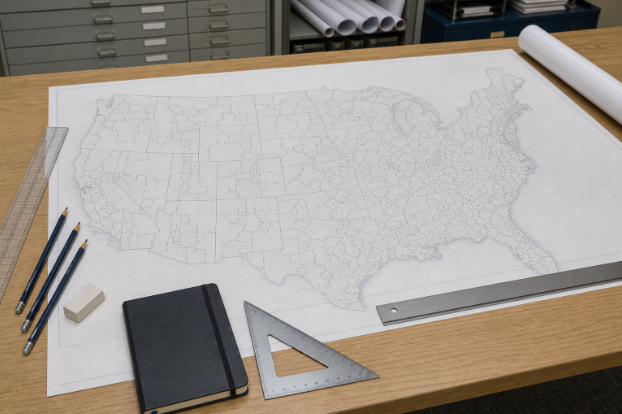
A Missouri judge ruled Wednesday that the state’s new Republican-drawn congressional map will be used in November — and that the citizens who gathered signatures to overturn it by referendum do not get to vote on it. The ruling removes one of the last obstacles to the largest wave of mid-cycle redistricting in modern American history: ten states have redrawn their congressional maps since the 2024 election, covering roughly 40 percent of all U.S. House seats, with Republicans positioned to gain as many as 16 seats from new maps in eight states and Democrats up to six from maps in two. With 75 days until the election, nearly all of those maps have now cleared the courts. The single live wildcard is Texas, where the Supreme Court has allowed the contested map to proceed for November while an appeal is pending.
What Happened in Missouri
Missouri’s Republican-led legislature redrew the state’s congressional map after President Trump urged Republican-controlled states to redraw boundaries ahead of the midterms. The new lines are designed to give Republicans a chance to defeat Congressman Emanuel Cleaver, the Kansas City Democrat who has held his seat since 2005. Opponents of the map responded with a tool Missouri’s constitution provides: a referendum petition, which allows citizens to force a statewide vote on a law passed by the legislature. They gathered signatures — and Republican Secretary of State Denny Hoskins refused to certify the petition. On Wednesday, August 19, Cole County Circuit Judge Daniel Green upheld that refusal, ruling that Missouri’s constitutional referendum provisions “do not apply to congressional redistricting enacted by the General Assembly,” that Hoskins’ decision was “lawful,” and that the map “remains in full force and effect for the 2026 general election.” The plaintiff, Richard von Glahn, appealed Wednesday evening. The ruling follows the Missouri Supreme Court’s decision in May allowing the map’s use in the August primary. The practical effect, unless the appeal succeeds quickly: the map’s opponents collected signatures to put the question to Missouri voters, and the question will not appear on any ballot.
How the Wave Happened
Congressional maps are ordinarily redrawn once a decade, after the census. The 2026 cycle broke that pattern. It began in the summer of 2025, when Trump publicly urged Republican-led states to redraw their districts mid-decade to protect the party’s narrow House majority, and Texas obliged. It accelerated on April 29, 2026, when the Supreme Court’s ruling in Louisiana v. Callais gutted Section 2 of the Voting Rights Act and effectively invited states to eliminate majority-minority districts that federal law had previously required — which Alabama, Louisiana, and Tennessee proceeded to do within weeks, including the elimination of Tennessee’s only majority-Black district, covered previously by The People’s Podium. By NBC News’ accounting, Republicans redrew maps in eight states: Texas, Missouri, North Carolina, Ohio, Florida, Tennessee, Louisiana, and Alabama. Democrats answered in two: California, where voters approved a counter-gerrymander, and Utah, where litigation produced a new map. Ten states, roughly 40 percent of the nation’s House seats, redrawn between elections — a scale of mid-decade line-drawing with no modern precedent.
Where the Courts Landed
The legal challenges have now largely run their course, and the maps have mostly survived. California’s map was cleared when the Supreme Court declined to hear a Republican challenge. Missouri’s cleared Wednesday, pending the fresh appeal. Alabama, Louisiana, and Tennessee’s post-Callais maps took effect for their primaries. The significant open question is Texas: a three-judge federal panel blocked the state’s 2025 map for use in 2026, but the Supreme Court stayed that ruling, allowing the contested map to be used in November while the appeal proceeds — meaning Texans will likely vote under a map a federal court found unlawful, with the final answer arriving after the election it governed. Ballotpedia and MultiState tracking also list ongoing litigation in Georgia, Louisiana, and New York that could still alter maps, though with each passing week the window for pre-election changes narrows toward zero. Courts consistently apply a doctrine — associated with the Supreme Court’s Purcell principle — against changing election rules close to an election, which now operates to protect whatever maps are currently in place.
What It Adds Up To
The arithmetic is stark but bounded. Republicans’ eight redrawn states position the party to gain up to 16 seats; Democrats’ two states offset up to six, for a potential net Republican gain approaching ten seats before a single vote is cast. In a House Republicans control narrowly, that is potentially the majority. But the maps have limits the mapmakers acknowledge. Analysts at Sabato’s Crystal Ball have modeled the new districts and concluded that if Democrats hold a solid national lead — they currently lead the generic ballot by roughly 7 points — the redrawn seats are unlikely to save the House majority, because a wave washes over gerrymandered lines. Gerrymanders are calibrated to normal years. The other cost is not partisan: districts drawn to disperse opposition voters, like the three-way split of Memphis or the targeting of Kansas City, produce representatives whose districts were engineered to predetermine the outcome — which is precisely what Missouri’s referendum campaign tried to put to a vote.
Where Things Stand
Seventy-five days remain. Overseas and military ballots begin going out in September under federal law, which makes further map changes progressively harder with each week. The Missouri appeal and the Texas Supreme Court case remain formally alive; everything else is set. The 2026 House election will be fought on the most aggressively redrawn national map in modern history, in a political environment that currently favors the party the maps were drawn against. Whether the lines hold against the environment is, at this point, the central question of the House midterms — and one the voters, unlike Missouri’s, will actually get to answer.