
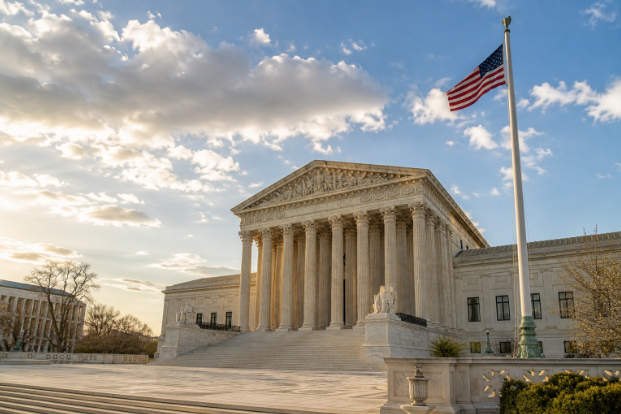
A three-judge federal panel found in 2023 that Alabama’s congressional map intentionally diluted the voting power of Black citizens. The court ordered the state to draw a new map. Alabama refused. The case went to the Supreme Court. On Tuesday night, in a 6-3 ruling along ideological lines, the Court sided with Alabama.
The 2026 congressional elections in Alabama will be conducted under a map that a federal court found was drawn to discriminate. Democratic Representative Shomari Figures, who currently holds a majority-Black district, will likely lose his seat. Justice Sonia Sotomayor wrote in dissent that the majority’s decision disregards both democratic values and the rule of law.
The Map
Alabama is 27 percent Black. After the 2020 Census, Republican state lawmakers drew a congressional map with seven districts. One of those seven districts has a majority-Black population. One out of seven, in a state where more than one in four residents is Black.
Civil rights groups and Black voters challenged the map under Section 2 of the Voting Rights Act. A three-judge federal panel agreed with them. The court found the map intentionally diluted Black voting strength and ordered Alabama to draw a second majority-Black district. The Supreme Court upheld that ruling in 2023. Alabama drew a new map anyway — again with only one majority-Black district. The lower court found that map unconstitutional too, just last week on May 26. Alabama appealed immediately.
In the 2024 elections, a court-drawn map with two majority-Black districts was used. Two Black Democrats were elected to Congress from Alabama. Tuesday night’s ruling means that map is gone. The Republican-drawn map takes over for 2026.
What the Supreme Court Said
The majority opinion was unsigned and three pages long. It did not engage substantively with the lower court’s finding of intentional discrimination. Instead, it said Alabama is likely to ultimately prevail on its claim that the map was lawfully drawn. The majority faulted the lower court for not sufficiently following its own recent ruling in a Louisiana redistricting case, which requires judges to largely defer to states’ partisan interests in drawing maps.
The majority also criticized the lower court for ruling close to the election — even though Alabama itself had delayed its primaries from May 19 to August 11 while scrambling to restore its preferred map. The state manufactured the time crunch and then argued the court was causing chaos by intervening.
The Dissent
Sotomayor, joined by Justices Kagan and Jackson, did not hold back. She wrote that the majority’s decision disregards both democratic values and the rule of law. She said the ruling would cause irreparable harm to Black voters who will be denied equal representation in the 2026 elections. She accused the majority of turning a blind eye to intentional discrimination.
A sitting Supreme Court justice wrote that her colleagues are allowing an election to proceed under a map a court found was intentionally discriminatory. The majority did not respond to that characterization in its three-page order.
The Bigger Wave
Alabama is not the only state rewriting its maps mid-decade. Tuesday night’s ruling is part of an unprecedented wave of fast-track redistricting that was kicked off by President Trump’s demand that Texas redraw its map to favor Republicans. Redistricting is normally done once a decade after the census. It is now being done on demand.
The Supreme Court’s Louisiana ruling last year told lower courts to give states more deference on redistricting decisions, even when race is alleged to be a factor. That ruling triggered what NBC News called a frenzy among mostly Southern states to redraw maps and eliminate majority-Black districts held by Democrats. Alabama is the first of those cases to reach the Supreme Court under the new standard. It will not be the last.
The practical message to Republican state legislatures is clear: if the maps favor the party, the Court will likely let them stand. Democracy Docket, which tracks voting rights litigation nationally, noted that the ruling signals continued deference to state partisan interests even when discrimination has been documented by a federal court.
Alabama’s Black voters will go to the polls in November with one fewer majority-Black congressional district than a federal court said the law requires — twice. The Supreme Court ruled Tuesday night that is acceptable. Sotomayor wrote that it is not. Representative Shomari Figures may no longer be in Congress next year because of it.
Sources: NBC News, Democracy Docket, Alabama Public Radio, ABC News, Supreme Court of the United States, African Elements